
Investing, 5 February 2024
Demystifying the S&P 500: A Beginner’s Guide to America’s Stock Market Powerhouse
by Chris Susanto
Who is this article for:
For the general public who wants to understand more about the S&P 500.
Have you ever heard of the S&P 500? This mysterious abbreviation often pops up in financial news, leaving many wondering: what exactly is it, and how does it impact my life?
Don’t worry; this comprehensive guide will help you unravel the mysteries of the S&P 500, making it understandable even for complete investing novices and the general public.
So, What is the S&P 500?

Imagine a huge room bustling with activities – that’s the S&P 500 in essence.
The S&P 500/Standard & Poor’s 500 is a famous index representing the 500 largest publicly traded companies in the United States based on market capitalization, encompassing sectors like healthcare, financials, technology, consumer goods, etc.
The S&P 500 was first introduced by financial services company Standard & Poor’s in 1957. Since its inception, it has become one of the most widely followed equity indices globally
Think of the S&P 500 as the American economy.
The performances of these top 500 largest publicly traded companies in the United States reflect the nation’s overall economic health.
Hence, making the S&P 500 a broad and diversified measure of the overall health of the stock market.
Why is The S&P 500 important?
Several reasons why the S&P 500 is an important reference point:
1. A Guide of How The Market is Doing: Its performance reflects the collective health of major American companies, offering a valuable guide for investors and economists.
2. Common Benchmark for Performance: Many actively managed funds aim to outperform the S&P 500, making it a benchmark for assessing their success.
3. An Investment Option: Investing in the S&P 500 through index funds provides instant diversification by holding a slice of each of these 500 companies.
Now, let’s delve into the numbers relating to the S&P 500:
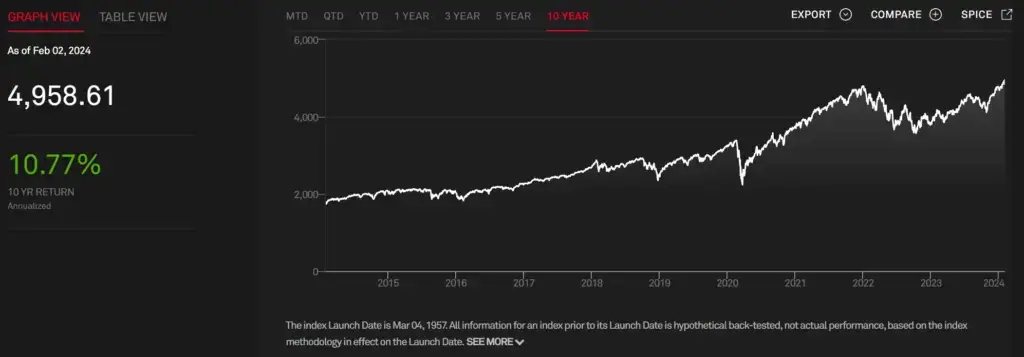
Source: S&P Global
1. Past Returns: The S&P 500 has historically delivered impressive returns. According to S&P Dow Jones Indices data, the average annual return for the S&P 500, including dividends, has been around 10% over the long term (decades).
Of course, past performance does not guarantee future results, but it still says something.
2. Volatility: Like any investment, the S&P 500 experiences ups and downs (there are years when the S&P 500 has negative returns as well as positive returns).
However, these fluctuations tend to smooth out over the long term, as evidenced by its historical upward trend. But again, past results are not a guarantee for future results.
One of the key reasons investors gravitate towards the S&P 500 is its historical stability and resilience. Despite periodic downturns and market fluctuations, the index has remarkably recovered and delivered consistent returns over extended periods.
What Warren Buffett Says About The S&P 500
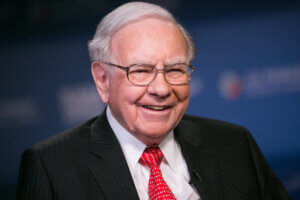
Image source: CNBC
Value investing legend Warren Buffett has been a vocal advocate for index funds tracking the S&P 500.
Warren believes that for most investors, passively investing in the entire index offers superior returns compared to actively picking individual stocks.
This philosophy emphasizes owning a piece of every major American company instead of betting on a select few, mitigating the risk of choosing underperformers.
Should You Add the S&P 500 to Your Portfolio?
The answer depends on your investment goals, risk appetite, risk tolerance and time horizon.
Here are some considerations:
a. Advantages of The S&P 500: Diversification, simplicity and low fees.
b. Disadvantages of The S&P 500: Lack of control over individual stock selection and potential underperformance compared to investing in successful individual stocks.
Is the S&P 500 an addition to picking stocks?
Warren Buffett is not “most investor, ” so he picks individual stocks.
One of my students actually also does both. He invests in the S&P 500 and picks individual stocks that he understands and thinks will outperform the market over the long run, potentially boosting his returns smartly.
I prefer picking individual stocks instead of buying the S&P 500.
For individuals interested in picking individual stocks, the S&P 500 can potentially serve as a complementary component in their investment strategy. While stock picking offers the potential for outsized returns, it also comes with higher risks.
Please do your due diligence before making any investment decisions. Ultimately, it is your hard-earned money.
Want to learn more? Here are some other valuable resources:
Investopedia: https://www.investopedia.com/terms/s/sp500.asp
Forbes: https://www.forbes.com/advisor/investing/what-is-sp-500/
S&P Global: https://www.spglobal.com/spdji/en/indices/equity/sp-500/
Disclaimer:
The information provided is for educational and general information purposes only and is not intended to be personalized investment or financial advice. We make no promises as to the accuracy or usefulness of the information we present.
Important: Please read our full disclaimer.
Disclosure:
I/we have no stock, option, or similar derivative position in any of the companies mentioned and no plans to initiate any such positions within the next 72 hours. I wrote this article myself, and it expresses my own opinions. I am not receiving compensation for it. I have no business relationship with any company whose stock is mentioned in this article.
Share the Love
Like the article that you just read? Share it!

About the writer
Chris Susanto is the Founder of Re-ThinkWealth.com. He is also a Board Member and Vice Chairman at Bansea and an Independent Director of Bansea Fund 2. Bansea, founded in 2001, is Asia’s oldest angel investment network.
Some of the places where Chris has been invited to speak or has added value as a mentor or writer include Singapore Polytechnic, SMU Institute of Innovation and Entrepreneurship (IIE), Seedly TV, Dollars and Sense, The New Savvy, Value Walk Blog, Investment Moats, NUS Tembusu College, NUS Investment Society, CGS-CIMB Singapore, Singapore Financial Conference by NTU IIC, The Financial Coconut Podcast, Money FM 89.3 and Internationally in Myanmar. He is also a part of the SMU BFI (Business Families Institute) network.
Chris also runs an investment education/coaching business called VIM/Value Investing Mentorship™. If you are interested in building your skills as a value investor, learn more about it here.
Want to read more articles?

Asbury Automotive: An Undervalued Gem in The Stock Market?
I have owned shares in Asbury Automotive Group, Inc., for about 18 months. Asbury is essentially a collection of …

Recession Fears and Value Investing: Navigating Uncertainty and Building Long-Term Wealth
In the past year, the world has been grappling with a looming recession and high inflation. There is a question of whether we […]

Conquering the Inner Market: Psychology for Investing Success
The concept of “Antifragile” is popularized by Nassim Nicholas Taleb in his book that is aptly named “Antifragile”. What is Antifragile? …

Becoming Antifragile in Stock Investing by Embracing The Volatility
The concept of “Antifragile” is popularized by Nassim Nicholas Taleb in his book that is aptly named “Antifragile”. What is Antifragile? …
Here’s How to Budget with Value Investing Principles
For a lot of people, budgeting their finances feels like a chore. In this article, I will share my thought process on how we view budgeting …

Beyond value investing: Timeless Insights from the Late Charlie Munger
Charlie Munger was not just an investment icon and the partner of Warren Buffett. He was also a master of navigating life’s complexities…
