
Investing
The Power of Compounding and Early Investing | RW Education Series
Chris Lee Susanto, Founder at Re-ThinkWealth.com
20 June 2019

Understanding The Power of Compounding
Albert Einstein says that compound interest is the eighth wonder of the world. He who understands it earns it and he doesn’t, pays it.
Now, what exactly does Albert means by that?
The power of compounding is amazing. It is something that young people generally, in my opinion, cannot appreciate and older people wished they had utilized when they were younger.
The power of compounding means that when we start to invest earlier than others (for example in our 20s or 30s), we will earn much more than others by a certain period of time (say by the time we are in our 50s and 60s).
This is because of compound interest.
Compounding happens when the returns that we received from our investments, in turn, receive a return on them as well.
It is “interest paid on top of interest”.
Here’s Why Utilizing The Power of Compounding Comes From Early Investing
The earlier you invest, the more time your money will be able to utilize compounding to make more money for you.
And the best part? You will not break a sweat, same effort, more returns.
For example, if in the first year you invested $10,000 and you earn a 10% return on your investments in the first year, your account grows to $11,000 and you have made yourself $1,000.
If you keep this investment intact, earning the same return of 10% in the second year will get you not $1,000 of profit but $1,100 of profit because you get the 10% return from the $11,000 not the $10,000.
Same return %, same effort, more money.
Now imagine this snowball effect for decades down the road.
Here are a few case studies to showcase my point.
Case Study 1 – Investing Earlier + Investing Lesser Years > Investing Later + Investing More Years
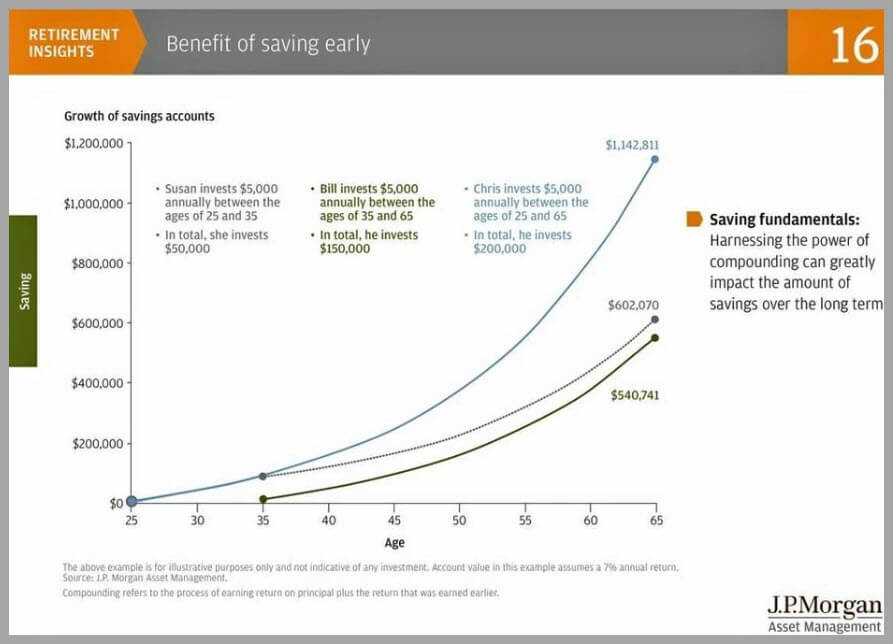
Source: JP Morgan
Susan who invested earlier ends up with more money than Bill at age 65 — even though Susan only invests for 10 years while Bill invests for 30 years.
The power of compounding.
Chris, on the other hand, is the best of the three (I am Chris too, good choice JP!).
Chris invested consistently throughout and is able to harness the full power of compound interest.
Case Study 2 – The Earlier One Start Investing, The Bigger The Compounding Effect Becomes

Source: Money Under 30
In the above example, there are three people — Michael, Jennifer, and Sam.
The example assumes a 7% rate of annual return for all 3 of them with the only difference being who started investing earlier.
So Michael started the earliest by saving $120,000 from age 25 to 35 and starting age 35, invested that $120,000. Then left the balance of $120,000 to accrue at 7% annual return until age 65 when he retired.
Jennifer only started saving at age 35 and only managed to save $120,000 by age 45 and started investing at that age. Then left the balance of $120,000 to accrue at 7% annual return until age 65.
Sam, on the other hand, invested $1,000 per month for 10 years, halted his savings at age 55 and left his money to accrue the investment return of 7% per year until the age of 65.
All three of them invested the same amount of capital of $120,000 but starting at different periods.
Michael ended with $1,444,969 which is more than double of Jennifer at $734,549 and almost five times of Sam ending balance at $373.407.
Summary – Use Compound Interest To Your Advantage, Start Investing Early
In summary, for young people, it is easy to not be keenly aware and take the necessary action to start increasing our earnings, savings and start investing early.
But the power of compounding and early investing is clear.
Albert Einstein says that compound interest is the eighth wonder of the world. He who understands it earns it and he doesn’t, pays it.
Albert is spot on.
Disclaimer:
The information provided is for general information purposes only and is not intended to be a personalized investment or financial advice.
Important: Please read our full disclaimer.
Read also now:
No Results Found
The page you requested could not be found. Try refining your search, or use the navigation above to locate the post.

My Stock Update: Keppel DC REIT Q2 DPU up 3.1%– Will I Sell?
What Keppel DC REIT Do Keppel DC REIT (SGX: AJBU) is a Singapore-based real estate investment trust (REIT). It was established with the main investment strategy of investing in a portfolio of income-producing real estate assets. They are primarily used for data centre...

Mr. Lim Say Boon, Chief Investment Officer of DBS Wealth Management’s 8 Predictions for The 2nd Half 2016 Market Outlook
This is what I have gathered from Mr Lim Say Boon, Chief Investment Officer of DBS Wealth Management's 8 predictions for the 2nd half 2016 market outlook: Brexit will not break EU but will break European stocks Global economy will continue to suffer and corporate...

Valuing Mobile Telesystems (NYSE: MBT) Using H Dividend Discount Model
Summary MBT is a telecommunications company with more than 100,000,000 subscribers and is Russia’s largest mobile operator and has high payout ratio close to their Free Cash Flow-- which warrant the use of dividend discount model (DDM) to value it H Dividend Discount...

Keryx Biopharmaceuticals Went Up 11.87% On 2 June 2016– BUT Should It?
Keryx Biopharmaceuticals (NASDAQ: KERX) As Part Of My Portfolio KERX is one of the more interesting stock in my portfolio-- and it is also a growth stock that has the potential to be a multi-bagger. What is a multi-bagger? "A multibagger is an investment that has...

Here Is What I Learnt From Watching Money Monster
I am a fan of George Clooney. The latest movie that he acted in is called Money Monster. This article aims to share what I have learnt from watching the movie-- from the perspective of someone who love investing. Before I share with you the lessons that I learnt, I...
#FAQ What To Take Note When Using Past Returns To Estimate Future Returns Of Stocks
Past Equal To Future? We have to take note that since expected returns we expect to receive from a stock investment is based on assumptions using past returns, we are basing the assumption that the past would equal to the future. This assumption would not be relevant...

Addition to My Family Portfolio- A Biotechnology ETF!
One of the first stock that I bought was called iShares Nasdaq Biotechnology ETF (NASDAQ: IBB). I bought it on 5th February 2015 at $310.51 and sold it on 13th July 2015 at $380, netting a cool 21.39%. I like biotechnology stock and so far I have had good experience...

7 Offline Channels For Leads And Their Real Cost
7 Offline Channels for leads and their real cost So much ado has been made about leads and their real cost. But what are the channels that you, the business owner or salesperson, can use to get more leads? The role of face-to-face event prospecting is in the business...
