
Investing
The Power of Compounding and Early Investing | RW Education Series
Chris Lee Susanto, Founder at Re-ThinkWealth.com
20 June 2019

Understanding The Power of Compounding
Albert Einstein says that compound interest is the eighth wonder of the world. He who understands it earns it and he doesn’t, pays it.
Now, what exactly does Albert means by that?
The power of compounding is amazing. It is something that young people generally, in my opinion, cannot appreciate and older people wished they had utilized when they were younger.
The power of compounding means that when we start to invest earlier than others (for example in our 20s or 30s), we will earn much more than others by a certain period of time (say by the time we are in our 50s and 60s).
This is because of compound interest.
Compounding happens when the returns that we received from our investments, in turn, receive a return on them as well.
It is “interest paid on top of interest”.
Here’s Why Utilizing The Power of Compounding Comes From Early Investing
The earlier you invest, the more time your money will be able to utilize compounding to make more money for you.
And the best part? You will not break a sweat, same effort, more returns.
For example, if in the first year you invested $10,000 and you earn a 10% return on your investments in the first year, your account grows to $11,000 and you have made yourself $1,000.
If you keep this investment intact, earning the same return of 10% in the second year will get you not $1,000 of profit but $1,100 of profit because you get the 10% return from the $11,000 not the $10,000.
Same return %, same effort, more money.
Now imagine this snowball effect for decades down the road.
Here are a few case studies to showcase my point.
Case Study 1 – Investing Earlier + Investing Lesser Years > Investing Later + Investing More Years
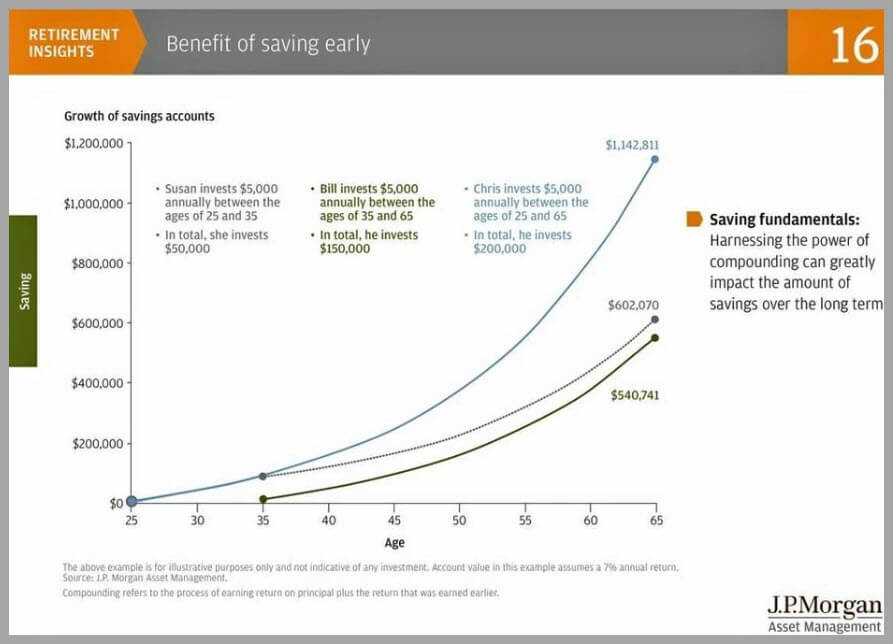
Source: JP Morgan
Susan who invested earlier ends up with more money than Bill at age 65 — even though Susan only invests for 10 years while Bill invests for 30 years.
The power of compounding.
Chris, on the other hand, is the best of the three (I am Chris too, good choice JP!).
Chris invested consistently throughout and is able to harness the full power of compound interest.
Case Study 2 – The Earlier One Start Investing, The Bigger The Compounding Effect Becomes

Source: Money Under 30
In the above example, there are three people — Michael, Jennifer, and Sam.
The example assumes a 7% rate of annual return for all 3 of them with the only difference being who started investing earlier.
So Michael started the earliest by saving $120,000 from age 25 to 35 and starting age 35, invested that $120,000. Then left the balance of $120,000 to accrue at 7% annual return until age 65 when he retired.
Jennifer only started saving at age 35 and only managed to save $120,000 by age 45 and started investing at that age. Then left the balance of $120,000 to accrue at 7% annual return until age 65.
Sam, on the other hand, invested $1,000 per month for 10 years, halted his savings at age 55 and left his money to accrue the investment return of 7% per year until the age of 65.
All three of them invested the same amount of capital of $120,000 but starting at different periods.
Michael ended with $1,444,969 which is more than double of Jennifer at $734,549 and almost five times of Sam ending balance at $373.407.
Summary – Use Compound Interest To Your Advantage, Start Investing Early
In summary, for young people, it is easy to not be keenly aware and take the necessary action to start increasing our earnings, savings and start investing early.
But the power of compounding and early investing is clear.
Albert Einstein says that compound interest is the eighth wonder of the world. He who understands it earns it and he doesn’t, pays it.
Albert is spot on.
Disclaimer:
The information provided is for general information purposes only and is not intended to be a personalized investment or financial advice.
Important: Please read our full disclaimer.
Read also now:
“The big money is not in the buying and selling, but in the waiting.”
Recently, I have come into the trap of being too focused on the short term price movements of stocks. A meaningful change that can occur in a company will not happen fast. It will take the fastest months and likely […]
What is The Meaning of Circle of Competence? | RW Education Series
Circle of competence is one of the key concepts that value investors apply to make money from the stock market. Warren Buffett often talks about the circle of competence concept but not many understood it. In this article […]
Life, Relationship, Health, Business & Value Investing – My Thoughts at 26
I have made a lot of mistakes in my life. I have been conned, cheated and have lost money in business deals and investments. Today is my birthday so I thought it would be good to summarize the important lessons I have learned so far about […]
The Return on Invested Capital/ROIC Formula | RW Education Series
Return on Invested Capital is an important formula we should look at when analyzing stocks. ROIC, in short, focuses on analyzing the profitability of a company. What is the formula for ROIC?
Return on invested capital […]
Singapore Airlines SIA Retail Bond 2019 – My Thoughts
My take on SIA Retail Bond 2019 where I discussed the pros, cons and overall, my thoughts on it. And whether I would invest in it or not. A few good things to say about it, and some things I thought that people should at least be informed on. Instead of using […]
The Best Value Investing Course in Singapore – VIM Mentorship?
Value Investing Mentorship is created with the goal to be the most effective and exclusive value investing online program. The approach is using twelve exclusive one to one educational lessons that come with assignments to do after each session. With the benefits of […]
Like Investing, Selling Options is Equally Hard. Here’s Why.
Having multiple streams of income is important in my life. In stock investments, most investors I know get their streams of passive income from capital gains and dividends. Getting premiums/cash flow through selling options is another strategy I often use. But all the serious investors will tell you […]
The Intelligent Investor Summary (Ultimate Guide) | Re-ThinkWealth
Warren Buffett said that The Intelligent Investor is the best book ever written on investing. This book contains over 600 pages of wisdom. The wisdom that serves as the building blocks for all value investors. This is The Intelligent Investor Summary. Enjoy! Warren Buffett […]
To Make Decisions Like Charlie Munger, Understand Your Emotions Well
The quality of our thinking creates the quality of our life. If the above sentence is true, then Charlie Munger must have made plenty of high-quality decisions over the course of his lifetime. Charlie is currently worth about US$1.8 Billion. He is the right-hand man of Warren Buffett who […]
5 Things to Do During A Stock Market Crash | Re-ThinkWealth
If you are an investor of stocks, you would know that currently (as of November 2018), we are in a (or nearing) stock market correction/bear territory. Before things get worse, here are 5 intelligent things to do during any stock market crash. Here is your playbook for successful investing:
The 100+ Most Intelligent Value Investing Quotes of All Time | Re-ThinkWealth
This list summarizes 100+ of the best value investing quotes of all time. They are spoken from some of the best value investing minds in the industry that I have modeled after for my investing philosophy. Both that have passed away (Benjamin Graham) and those that are […]
Is Spotify Stock Invest-Worthy? Seeing it From A Value Perspective.
Daniel Ek has built a great business with Spotify. Now that it has recently IPO-ed in 2018, is this digital music streaming service of his, invest-worthy? I am sure that by now you would most likely have heard of Spotify before. But I am sure that not many of you know that Spotify was founded and […]

Is Snowflake (NYSE: SNOW) Worth Investing? Here Are My 5 Takeaways
Snowflake does cloud computing that implements a variable pricing model, which can be at times more attractive than fixed packages […]
Nasdaq Is Officially In A Correction Territory: What Is Next?
The adage that “In the short run, the market is a voting machine but in the long run, it is a weighing machine.” by Benjamin Graham could not be more true over the past few days. As of 9 September 2020, […]

My 3 Thoughts on Yesterday’s Deepest US Market Decline Since June
Yesterday (3 September 2020), the US market had its deepest one day decline since June. The S&P 500 and Nasdaq had their deepest declines since June 11 and for Dow, it was their biggest decline since June 26 […]

Will The Stock Market Crash One More Time in 2020?
My Bet: In 2020, The Stock Market Will Not Crash Again. Yes, it is hard to predict where the stock market is heading in the short term. But my bet with regards to virus-related concern is that I do not think that we will crash again back to March-April Lows in 2020 just because of it […]

Is SIA Shares Worth Buying? Here Are My Thoughts (August 2020)
Think About How SIA Was When Times Was “Normal” Before we got into this COVID-19 mess, SIA is already not a great business to own even when times were “normal.” All of us know that the airline […]

The Eight Accounting Fraud or Red Flag Signs To Look Out In Stocks
In this article, I’d like to share eight signs of potential fraud in our stocks portfolio that we should be careful of. These are eight simple potential warning signs of bad financial reporting or early markers […]

My 5 Key Takeaway From AEM Holdings 1H 2020 Results
3. As of 1H20, Most Earnings Paid Out As Dividends Based on AEM 1H20 reports, their cumulative capital allocation breakdown from 2017 to 1H2020 is as follows: Dividends – 47%, Acquisitions – 25%, Capex – 18%, Buybacks – 10%. It is interesting to note that […]

Kodak Stock is Up Over 1,400% in Two Days. Does It Make Sense?
Eastman Kodak Company (NYSE: KODK) opened at $2.15 (Monday) on July 27, 2020, and closed at $33.20 (Wednesday) by 29 July 2020. That is a 1,444.19% increase over a two day period. In this article, I am going to give you some background on the Kodak company, the reason […]
