Reflections
Mastering Risk vs. Return in Investing | Re-ThinkWealth
24 February 2023
Who is this article for:
For anyone who wants to understand the relationship between risks and returns in investing and how to potentially mitigate them
Mastering risk and return

Risk and return are two of the most important concepts in investing.
The relationship between these two factors is crucial to understanding how to invest effectively and achieve your financial goals.
In this article, we will explore what risk and return are, how they are related, and how you can manage the tradeoff between them to maximize your investment returns.
Most importantly, understand key concepts such as why risks and uncertainties are different.
What is risk?
In the context of investing, risk refers to the known variability of investment returns, and in my view, the biggest risk in investing is permanent loss of capital.
All investments carry some level of risk, as it is impossible to predict with certainty what will happen in the future.
The degree of risk associated with an investment depends on a variety of factors, including the type of investment, the economic environment, and the individual characteristics of the investment.
There are many different types of investment risk, including:
1. Market Risk: This refers to the risk of losses due to fluctuations in the overall market, such as changes in interest rates, economic growth, or geopolitical events.
2. Credit Risk: This refers to the risk of default by the issuer of a bond or other debt instrument.
3. Liquidity Risk: This refers to the risk of not being able to sell an investment when you want to due to a lack of buyers in the market.
4. Inflation Risk: This refers to the risk of loss of purchasing power due to inflation.
5. Currency Risk: This refers to the risk of losses due to changes in exchange rates between currencies.
There are many other types of investment risk, but these are some of the most common.
What I do not consider a risk, however, is volatility in the stock market, which goes against some schools of thought.
Volatility, in my view, is an opportunity.
What is the difference between risk and uncertainty?
Risks are situations where the potential outcomes and rough probabilities are known to the decision-maker.
Uncertainties, on the other hand, are situations where the outcomes and/or the rough probabilities of occurrences are unknown to the decision-maker.
For example, when Covid 19 first came, there were a lot of uncertainties because it has been about 100 years since the past pandemic happens.
In uncertain times, outcomes are generally unknown.
Risks, on the other hand, can be controlled or potentially understood, and risks can be managed.
Even though there is no such thing as perfect knowledge, the probabilities are generally known in risks, while the outcome and probabilities are generally not known in uncertainties.
What is return?
Return, on the other hand, refers to the profit or income earned from an investment.
There are many different types of investment returns, including:
1. Capital Gains: This refers to the increase in the value of an investment over time. For example, if you buy a stock for $30 and sell it for $60, you have earned a capital gain of $30.
2. Dividends: This refers to the income earned from owning stocks or other investments that pay regular dividends.
3. Interest: This refers to the income earned from owning bonds or other debt instruments that pay regular interest payments.
4. Rental Income: This refers to the income earned from owning rental properties or other real estate investments.
5. Royalties: This refers to the income earned from owning intellectual property, such as patents or trademarks.
There are many other types of investment returns, but these are some of the most common.
Another less common types of return are income earned from options premiums through selling options.
The Relationship Between Risk and Return
In general, there is a positive relationship between risk and return.
This means that investments with higher levels of risk typically have the potential for higher returns, while investments with lower levels of risk typically have lower potential returns.
For example, stocks are generally considered to be riskier investments than bonds, as the value of a stock can be more volatile due to changes in the overall market. However, stocks also have the potential for higher returns over the long term.
On the other hand, bonds are generally considered to be lower-risk investments, as they pay a fixed interest rate and are less likely to fluctuate in value. However, the returns on bonds are generally lower than the potential returns on stocks.
The tradeoff between risk and return is an important consideration for investors. In general, investors must take on some level of risk in order to achieve higher returns, but they must also be willing to accept the possibility of losses. The key is to find a balance between risk and return that is appropriate for your individual goals and risk tolerance.
Managing the tradeoff between risk and return
It is important to note that higher returns are not guaranteed and that the risk of loss is also greater in high-risk investments. Conversely, low-risk investments generally provide lower returns but also offer a greater degree of safety and stability.
There are several strategies that investors can use to manage the tradeoff between risk and return. Here are a few examples:
1. Determine your risk tolerance: Risk tolerance refers to an individual’s willingness to accept risk. It is important to understand your own risk tolerance before making any investment decisions. If you are uncomfortable with high levels of risk, then investing in high-risk assets may not be the best option for you. Conversely, if you are comfortable with taking on more risk, then you may be able to achieve higher returns by investing in higher-risk assets. But the risk is also highly proportional to your own skills and knowledge that you have built up over time, so never stop learning and growing.
2. Diversify your portfolio: Diversification is one of the many strategies for managing risk. By investing in a variety of assets, you can spread your risk and reduce the impact of any individual asset on your overall portfolio. This can help to mitigate losses and stabilize returns. But this will also limit your upside and returns.
3. Consider your investment goals and time horizon: Your investment goals and time horizon should also be taken into account when managing the tradeoff between risk and return. If you have a long-term investment horizon, then you may be able to take on more risk in pursuit of higher returns. However, if you have a short-term investment horizon or specific financial goals, then lower-risk investments may be more appropriate.
4. Keep an eye on market conditions: Market conditions can have a significant impact on the risk and return of investments. Keeping an eye on market trends and adjusting your investment strategy accordingly can help you manage risk and optimize returns
Ultimately, my view is that the biggest risk in investing is always ourselves. Our emotions, our fears, and our greeds are the biggest risk in investing.
So to manage risks better, we should never stop learning and growing over the course of our life.
It is only when we get better we are able to respond better and make better investment decisions over time. I believe that the best way to manage risk and achieve returns – is to never stop learning and never stop growing.

Image Source: Ray Dalio
As Ray Dalio says, evolve or die.
Disclosure:
I/we have no stock, option, or similar derivative position in any of the companies mentioned and no plans to initiate any such positions within the next 72 hours. I wrote this article myself, and it expresses my own opinions. I am not receiving compensation for it. I have no business relationship with any company whose stock is mentioned in this article.
Disclaimer:
The information provided is for educational and general information purposes only and is not intended to be personalized investment or financial advice. We make no promises as to the accuracy or usefulness of the information we present.
Important: Please read our full disclaimer.
Free Telegram Channel
Be the first to be notified of our new articles by joining our Free Telegram Channel here: https://t.me/rethinkwealth.
Share the Love
Share this knowledge around (:

Chris Susanto
Chris is the Founder of Re-ThinkWealth.com & VIM (Value Investing Mentorship Club®), as well as the Co-Founder of Alevate Invest.
He is also a Board Member at Bansea and an Independent Director of Bansea Fund 2. Bansea is Asia’s oldest angel investment network, founded in 2001.
Chris started investing in stocks early at age 21 and is a big proponent of business-like stock investing – a mixture of value and growth investing.
He invests in listed companies where there is value to be found (as long as it is still within his circle of competence), be it a turnaround, depressed, value, or quality growth company (compounders).
Some of the places where Chris has been invited to speak or has added value as a mentor or writer include Singapore Polytechnic, SMU Institute of Innovation and Entrepreneurship (IIE), Seedly TV, Dollars and Sense, The New Savvy, Value Walk Blog, Investment Moats, NUS Tembusu College, NUS Investment Society, CGS-CIMB Singapore, Singapore Financial Conference by NTU IIC, The Financial Coconut Podcast, Money FM 89.3 and Internationally in Myanmar. He is also a part of the SMU BFI (Business Families Institute) network.
Chris is also a practitioner of Transcendental Meditation.
“Meditation, more than any other factor, has been the reason for what success I’ve had. Meditation leads to openness, to freedom, where a kind of intuition just comes through. You could step back and put things in perspective” – Ray Dalio on Transcendental Meditation, founder of the largest hedge fund in the world with $140 Billion under management.
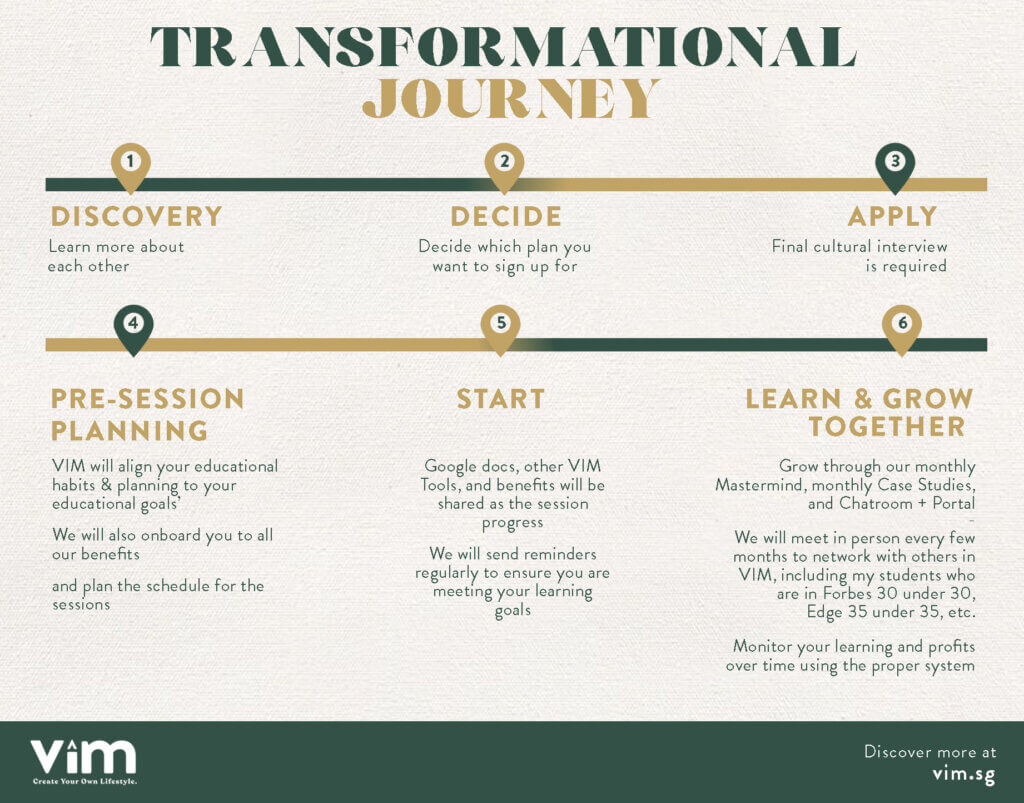
Maximize Your Value Investing Knowledge, Learning, and Application with VIM – We mentor business owners and senior professionals to make a second source of income by investing and growing with listed companies in the stock market 📈- Discover more here.
If you are also on LinkedIn, feel free to connect with Chris on Linkedin here and say hi!
Don’t leave yet, read:
Beyond value investing: Timeless Insights from the Late Charlie Munger
Charlie Munger was not just an investment icon and the partner of Warren Buffett. He was also a master of navigating life’s complexities…
WeWork: Would An Investment in WeWork Have Worked Out?
WeWork looming bankruptcy. But would an investment in WeWork have worked out, ever? In this article, we look into the story and …

A Beginner’s Guide to Value Investing in Singapore
Value investing is an investment strategy that seeks to buy stocks that are trading below their intrinsic value. This means that the stock is …
