
Reflections
Strategic Positioning: How to Win Without Predicting the Future
By Chris Susanto,
Editor at Re-ThinkWealth
Founder at Value Investing Mentorship
Most people treat their lives like a lottery ticket. They pick a number—a specific career goal, a dream house, a retirement date—cross their fingers, and hope the world cooperates.
This is a gambler’s mindset. And as value investors, we know that gamblers eventually go broke.
The most successful investors I know—and the happiest people I’ve met—don’t try to predict the future. They don’t bet the farm on a single outcome. Instead, they focus on one thing: Positioning.
Life isn’t about predicting the exact moment the market turns; it’s about standing where the opportunity is flowing. It is about constructing a portfolio where the downside is capped, and the upside is huge.
Here is why you need to stop planning and start positioning.
1. The Fallacy of the “Five-Year Plan”
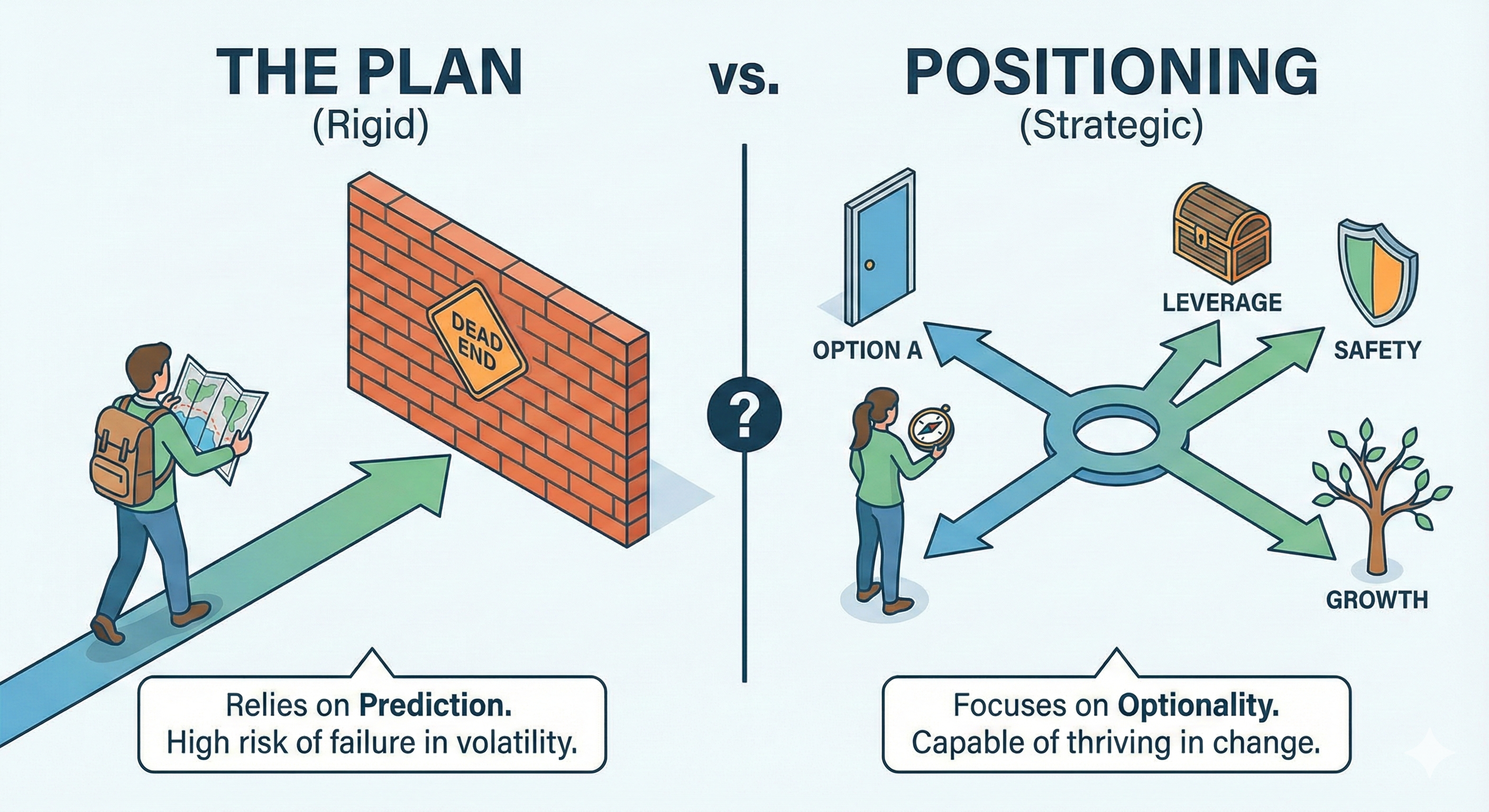
We are taught to love the “Five-Year Plan.” It feels safe. It looks responsible on a PowerPoint slide.
But the world is volatile. A pandemic, a market crash, or a technological breakthrough can render a rigid plan obsolete overnight. If your plan requires the world to stay still for five years, you are shorting volatility. You are betting against change.
Positioning is the opposite.
Good positioning means you are robust enough to survive the bad times and agile enough to capitalize on the good times. It is the difference between having a map (a rigid plan) and having a compass (positioning). When the terrain changes, the map becomes useless. The compass always works.
The Rule: Don’t ask “What will happen in 5 years?” Ask “What position can I take today that will benefit me no matter what happens in 5 years?”
We want to be antifragile.
2. Seek Options That Give You Options
In finance, we talk about “Convexity.” A convex bet is one where if you lose, you lose a little, but if you win, you win a lot.
In life, this translates to Optionality.
Every decision you make leads to a room with doors.
Bad decisions lead to rooms where the doors lock behind you. (e.g., High-interest debt, a criminal record, a toxic relationship).
Good decisions lead to rooms with 10 more open doors. (e.g., Learning a universal skill, saving cash, building a network).
You want to relentlessly move into options that give you more options.
When you learn to invest in stocks, or learn to write, or learn to sell, you aren’t just learning a trade. You are acquiring a key that opens thousands of doors. You are positioning yourself so that when a “lucky break” floats by, you actually have the capacity to grab it.
3. Leverage: Moving the World Without Breaking Your Back
Archimedes said, “Give me a lever long enough and a fulcrum on which to place it, and I shall move the world.”
If you are trading your time for money (pure salary), you have zero leverage. You are moving the world with your bare hands. It is noble, but it is slow, and it has a ceiling.
To maximize your return on life, you need to apply leverage to your positioning.
The Three Forms of Modern Leverage:
- Capital: Money working for you while you sleep. (This is why we invest, and why I teach at VIM).
- Labor: Hiring smart people to execute your vision.
- Zero-Marginal Cost Media: This is the new gold. Code and Media.
This blog post is a form of leverage. I write it once (fixed cost), but it can be read by 10 people or 10,000 people without me doing any extra work. That is infinite leverage.
Position yourself in activities where the inputs are disconnected from the outputs. Where an hour of good judgement creates a decade of dividends.
4. Capping the Downside (The Barbell Strategy)
You cannot compound if you hit zero.
In investing, a 50% loss requires a 100% gain just to get back to even. In life, “ruin” is hard to come back from. Ruin is blowing up your reputation. Ruin is neglecting your health until it’s too late. Ruin is taking on leverage that can wipe you out.
The “Barbell Strategy” for Life: Nassim Taleb popularized the idea of the barbell.
On one end: Be hyper-safe. Keep your day job, keep a cash emergency fund, nurture your family. (Cap the downside).
On the other end: Take wild, high-upside risks. Start that side business. Invest in that stock that can potentially turnaround. Write that bold book.
The middle is where people get crushed. The middle is the “safe” corporate job that slowly erodes your soul and lays you off at 50 with no backup plan.
The Verdict
Positioning isn’t passive. It is active preparation.
It is accumulating cash so you don’t have to sell assets in a crash. It is accumulating skills so you don’t have to fear a recession. It is accumulating relationships so you are never truly alone.
Stop trying to predict the outcome. Start improving your position.
Disclaimer:
The information provided is for educational and general information purposes only and is not intended to be personalized investment or financial advice. We make no promises as to the accuracy or usefulness of the information we present.
Important: Please read our full disclaimer.
Disclosure:
I/we have no stock, option, or similar derivative position in any of the companies mentioned and no plans to initiate any such positions within the next 72 hours. I wrote this article myself, and it expresses my own opinions. I am not receiving compensation for it. I have no business relationship with any company whose stock is mentioned in this article.
Don’t Navigate the Market Alone
Get curated mental models, visual investing wisdom, and priority access to the next Mentorship intake—delivered straight to your phone.

About the writer
I believe the stock market isn’t a casino—it’s the greatest tool ever invented for owning pieces of the world’s best businesses.
I started this blog in 2015 out of an obsession with Value Investing. That passion evolved into VIM (Value Investing Mentorship), where I now help busy Executives and CEOs build their own “compounding machines” so they can detach their income from their time.
Beyond the markets, I have served on the Board of Bansea (Asia’s oldest angel network) and the SPGG (Singapore Polytechnic Graduates’ Guild). You may have also heard me sharing insights on Money FM 89.3, the Singapore Financial Conference, or Seedly TV.
Unsure how to start? Click here to begin your journey.
Don’t go yet, read more now:
Options Selling Strategy – Wk 3 June 2017 (GameStop Inc (NYSE: GME)
Options Selling Options Selling Strategy – Wk 3 June 2017 (GameStop Inc (NYSE: GME) Chris Lee Susanto, Founder and CEO, Re-ThinkWealth 16 June 2017 SUMMARY: Options are a form of financial derivatives Options selling strategy have stocks as...

GameStop Corp (NYSE: GME)– A Cigar Butt Investing Play
Top Articles GameStop Corp (NYSE: GME)– A Cigar Butt Investing Play Chris Lee Susanto, Founder and CEO, Re-ThinkWealth 12 May 2017 SUMMARY: GameStop's valuation is at an all-time low Gross profit margins have been doing well Debt management is good I...
UPDATE: Sold Off All My Stocks In Mobile Telesystems (NYSE: MBT) And This Is What I Learnt From It
Summary Mobile Telesystems (NYSE: MBT) is the biggest stock holdings I had for over two years and it is also the first stock that I bought in my life My absolute gain for this stock is about 34.15% A review of the earnings and revenue growth of MBT indicated an...
![[Edited] Importance Of Knowing When To Sell Your Stocks Cannot Be Understated](https://www.re-thinkwealth.com/wp-content/uploads/2017/03/blur-1853262_640.jpg)
[Edited] Importance Of Knowing When To Sell Your Stocks Cannot Be Understated
"Knowing when to sell your stocks is as important-- or even more important-- than knowing when to buy them."- Chris Lee Susanto My Experience I have had experiences in buying stocks of good companies that quickly went to two years high price after I bought it earning...
![[Edited] Apple Sued Qualcomm. Here Is Why I Bought It.](https://www.re-thinkwealth.com/wp-content/uploads/2017/02/apple-qualcomm-1080x675.png)
[Edited] Apple Sued Qualcomm. Here Is Why I Bought It.
In February 2017 I initiated a position on Qualcomm (NASDAQ: QCOM)-- a few days after it was sued by Apple-- when stock price plunged 12%-- for receiving unreasonable royalty fees via leveraging on their monopoly in the chip making industry. Apple sued Qualcomm and I...
My 10 Biggest Takeaways from Warren Buffett and Peter Lynch
Who is Warren Buffett? Born 1930, Omaha, Nebraska Started managing funds in 1956 with the formation of the Buffett Partnership (dissolved in 1969). Now chairman and major owner, Berkshire Hathaway Inc $1,000 invested with Buffett in 1956 would be worth $ 25,289,750 as...