Reflections
VIM Introduces New Logo & Reflects on It’s Transformation over the Years
Chris Susanto,
Founder, Board Member and Mentor
This article is suitable for:
Followers of Re-ThinkWealth.com and VIM.
What is VIM?
VIM stands for Value Investing Mentorship™.
We are essentially a private investment community for CEOs and Executives to stop trading time for money and learn how to invest in great companies in the stock market for the long term.
The idea is really for our mentees/students to learn how to create their own lifestyle through understanding how to grow their wealth in a non-linear way through investing in shares of listed companies.
Why Rebrand VIM?

Source: VIM
I started the first version of VIM in 2018, and as I have also evolved as a person and as an investor since then, the brand VIM should change accordingly.
I wanted a brand that exudes the exclusivity of our private investment community while also making the brand and its colours more whole, solid, and mature.
Source: VIM
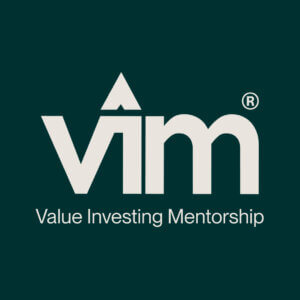
I think our new brand and logo did just that, with a darker shade of green (compared to the previous version) and a more whole/integrated logo (notice the “V” and “I’ are connected in the new logo).
Our distinctive new green colour evokes maturity and wisdom. This green will serve as the bedrock of the new VIM brand.

Source: VIM
The new VIM arrow emblem is the definitive symbol of our new brand identity. The arrow symbolizes the convergence of an upward arrow and a home. It represents the journey towards our long-term learning and growth as investors, guided by strong mentorship and support.
To give each mentee/student as much attention and focus as I can, we are therefore capping the community at 150 active members. This way, I will be able to curate the community and build in-depth, long-term relationships with each mentee/student.
Conclusion
I am excited for the next phase of the VIM family journey.
Currently, we are already at about 1/3 capacity on our 150 mentees/students cap in our high-quality community of mainly business owners/executives.
Looking forward to more awesome people joining our kind, friend and genuine community to learn how to be a better investor and acquire this life-long money making skill together.
Disclaimer:
The information provided is for educational and general information purposes only and is not intended to be personalized investment or financial advice. We make no promises as to the accuracy or usefulness of the information we present.
Important: Please read our full disclaimer.
Disclosure:
I/we have no stock, option, or similar derivative position in any of the companies mentioned and no plans to initiate any such positions within the next 72 hours. I wrote this article myself, and it expresses my own opinions. I am not receiving compensation for it. I have no business relationship with any company whose stock is mentioned in this article.
Be an Insider!
Join our FREE telegram channel NOW.
Like what you just read? share it.

About the writer
I simply love investing. The stock market allows us opportunities to acquire shares of truly great companies at sometimes really attractive prices.
In 2015, I founded this blog that you are currently reading out of my passion for value investing, an investing technique used by legends such as Warren Buffett.
In 2017, I started the first version of VIM, which stands for Value Investing Mentorship. Today, VIM is the private investment community for CEOs and Executives looking to stop trading time for money and learn how to invest in great companies listed in the stock market over the long run.
I also volunteer as a Board Member in Bansea, Asia’s oldest angel investment network, and in the Singapore Polytechnic Graduates Guild (SPGG), where I used to study. I am also an independent director in Bansea Angel Fund 2.
Over the years, I have been invited to speak on platforms such as Money FM 89.3, Singapore Financial Conference, CGS-CIMB, and Seedly TV, and I have also been featured in NUS Invest.
Right now, my focus is on teaching CEOs and Executives who are looking to learn how to invest in the stock market but unsure how to get started. If that sounds like you, click here to get started on your life transformation journey.
Don’t go yet, read more now:

My Week 3 Summary of Yale University Financial Markets Course: Theory of Debt
In this module, Professor Shiller discusses the theory of debt and its proper role. He also covers corporate stocks. A naïve view of what stocks are is that it is some certificate that people buy so that the price can go up. That is not what stocks are. Stocks...

The Federal Reserve Raises Interest Rate: What Does It Mean For Us?
After almost a decade, The Federal Reserve raises a higher interest rate for the first time. The Federal Open Market Committee unanimously voted to set the new target range for the federal funds rate at 0.25 percent to 0.5 percent, up from zero to 0.25 percent. Policy...
Will The Fed Finally Raise Interest Rate on 16 Dec 2015?
The expectation was based on Chair Janet Yellen's oft-repeated stance that she'd like to see rate rises before the end of 2015. The last time the United States Federal Reserve raised their interest rates was back in 2006, a decade ago. With shares and commodity...
Here Is Everything You Need To Know About The Singapore Savings Bonds
What Are Bonds Bonds are one of the methods for corporations and governments to raise funds. It is a form of borrowing whereby we lend money to the government or corporations and we earn interest on it. We are able to redeem the principal amount but normally there is...

Seven Steps For Starting A Conversation
The seven steps for starting a conversation at a party Give a sincere smile and say Hello Provide a short introduction of who you are and give a firm handshake Listen closely to the person's name - Ask them to repeat it if you did not hear it clearly the first time...
My Week 2 Summary of Yale University Financial Markets Course: The History and Real Impact of Behavioral Finance
The History and The Real Impact of Behavioural Finance People are complex and our financial institutions are designed for real people. This study of behavioural finance started because of the revolution of neuroscience and the fact that the human brain is a...
