Reflections, 2 November 2023
WeWork: Would An Investment in WeWork Have Worked Out?
Written by Chris Susanto
Founder of Re-ThinkWealth.com and VIM (Value Investing Mentorship™)
Who is this article for:
For readers who would like to understand more about the story and history of WeWork and towards the current potential looming bankruptcy.
What is Happening to WeWork?

Source: Google
WeWork shares are plunging in the US stock market after reports saying that WeWork is filing for bankruptcy. In the New York Stock Exchange, its shares fell by close to 50%. WeWork stock was first listed on NYSE in 2021 through a SPAC (special purpose acquisition company) under BowX Acquisition Corp. WeWork’s shares have plunged by more than 98% this year.
In August this year, WeWork already raised doubt about its ability to continue operations. Eventually, many top management, including WeWork CEO and chairman, Sandeep Mathrani exited the company.
WeWork History
WeWork is one of the many companies backed by Softbank.
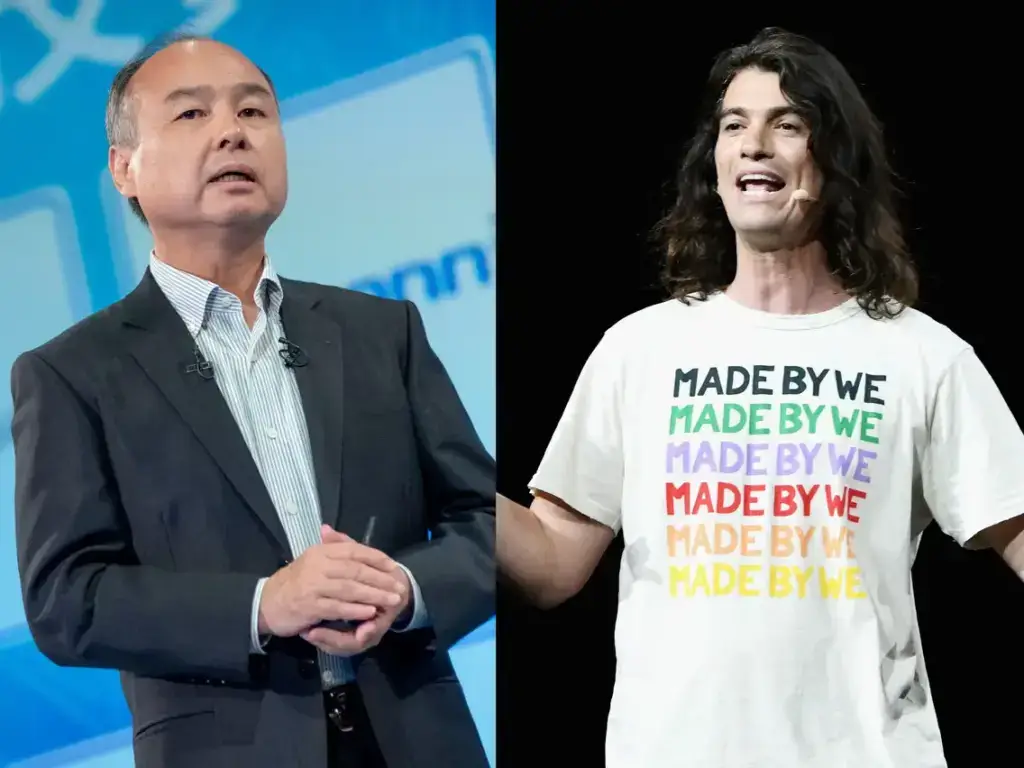
Image source: Business insider
Masayoshi Son, the CEO of Softbank met less than 30 minutes with Adam Neumann in 2016 before deciding to invest in WeWork. All in all, Softbank reportedly invested over $18bn in WeWork.
WeWork used to be known as the future of office workspace.
At WeWork’s height, it was valued at around $47bn in early 2019 due to SoftBank’s $2 billion investment round in 2019.
The 2019 WeWork IPO effort did not work out. Because in 2019, there were plenty of red flags.
For example, it was found out that there were potential conflicts such as Neumann having an interest in four buildings that WeWork leased. Neumann had also gotten personal loans from the company at below-market rates to fund his lifestyle and he had also purchased the trademark to the “We” name through a holding company and WeWork paid him $5.9 million to license it.
WeWork ended up IPO-ing at a valuation of only $9 billion in 2021, less than 5 times its initial valuation target in 2019.
Fast forward to 2023, WeWork had lost over 95% of its stock market valuation. As of 2 November 2023, its market capitalization is only around $63m.
What Will Happen to WeWork?
Will they actually go bankrupt and file Chapter 11? It remains to be seen.
Yes, WeWork had missed interest payments to their bondholders on Oct 2, which kicked off a 30-day grace period in which it needs to make payments, failing to do so is considered default.
The latest news is that WeWork told US financial regulators that they had agreed with creditors to temporarily postpone payments for some of their debt.
As of 1 Nov 2023, WeWork insisted that it is still business as usual in Singapore amid the talk of the US parent company’s possibility of going bankrupt.
Only time will tell if they will indeed file chapter 11. It definitely seemed to be leaning that way.
Could WeWork have worked out?

Source: YCharts
As you can see from the chart above, as of June 2023, WeWork has close to $3bn in debt and only $205m in cash and equivalents. And they are still losing over $1.6bn (negative net income) on a trailing twelve-month basis.
Yes, of course, the pandemic has also hit WeWork badly as more people started working at home instead of from a co-working space. That makes shared office spaces like WeWork not as appealing.
Based on WSJ, as of June 2023, WeWork maintained 777 locations across 39 countries, including 229 locations in the U.S. They also have an estimated $10bn in lease obligations due starting from the second half of 2023 through the end of 2027. And an additional $15bn from 2028 onwards.
Based on my view, WeWork would never have worked out. Doing long-term leases and renting them for the short term is a tough business to be in. But the main problem in my view is WeWork grew too fast, borrowed too much, and did not have enough discipline and control to make it a sustainable business.
But Adam Neumann, the founder of WeWork had a happy ending back in 2021 by exiting WeWork with a $445m payout in a nice exit package. Even though the company is losing money still.
And did you know that WeWork’s ex-co-founder and CEO, Adam Neumann goal was not just to make money or rent office space, but is to “change the world.”?
Disclaimer:
The information provided is for educational and general information purposes only and is not intended to be personalized investment or financial advice. We make no promises as to the accuracy or usefulness of the information we present.
Important: Please read our full disclaimer.
Disclosure:
I/we have no stock, option, or similar derivative position in any of the companies mentioned and no plans to initiate any such positions within the next 72 hours. I wrote this article myself, and it expresses my own opinions. I am not receiving compensation for it. I have no business relationship with any company whose stock is mentioned in this article.
Share the Love
Like the article that you just read? Why not share it with your friends, feel free to tag us.

About the writer
Chris Susanto is the Founder of Re-ThinkWealth.com. He is also a Board Member and Vice Chairman at Bansea and an Independent Director of Bansea Fund 2. Bansea is Asia’s oldest angel investment network, founded in 2001.
Some of the places where Chris has been invited to speak or has added value as a mentor or writer include Singapore Polytechnic, SMU Institute of Innovation and Entrepreneurship (IIE), Seedly TV, Dollars and Sense, The New Savvy, Value Walk Blog, Investment Moats, NUS Tembusu College, NUS Investment Society, CGS-CIMB Singapore, Singapore Financial Conference by NTU IIC, The Financial Coconut Podcast, Money FM 89.3 and Internationally in Myanmar. He is also a part of the SMU BFI (Business Families Institute) network.
Chris also runs an investment education company called VIM/Value Investing Mentorship™. If you are interested in building your skill as a long-term stock investor, learn more about us and arrange a discovery call here.
Want to read more of my articles?

How Warren Buffett Use Put Options to Increase Berkshire’s Returns
You might know Warren Buffett from Berkshire Hathaway as a stock picker. But not many people know he has made a lot of money by selling put options. In this article, you will learn […]

Nasdaq & S&P 500 At A New High – Here’s What It Means
As of today, the Nasdaq & the S&P 500 has hit a new high. Recently, the US economy showed that GDP grew 2.1% annually in the second quarter of this year. It means that consumer is still […]

Get Wealthy Through Stocks (Value Investing Lessons from Pat Dorsey)
Warren Buffett’s definition of intrinsic value is “the discounted value of the cash that can be taken out of a business during its remaining life”. Now take a moment to pause and think about the above definition […]

Intrinsic Value of Stock: Here’s What It Means Based on Warren Buffett
Warren Buffett’s definition of intrinsic value is “the discounted value of the cash that can be taken out of a business during its remaining life”. Now take a moment to pause and think about the above definition […]

The Power of Compounding and Early Investing | RW Education Series
Albert Einstein says that compound interest is the eighth wonder of the world. He who understands it earns it and he doesn’t, pays it. Now, what exactly does Albert means by that? The power of compounding is amazing […]

What Are Treasury Bills/Bonds/Notes? | RW Education Series
Just like how companies take on debt from banks and pay interest to them in order to fund their operations, selling U.S. treasury bills/bonds/notes are one way the U.S. government raise funds to finance their […]
