
Growth or Value Investing? Why Not Both?
27 July 2021
What is The Traditional Definition of Value and Growth Investing?
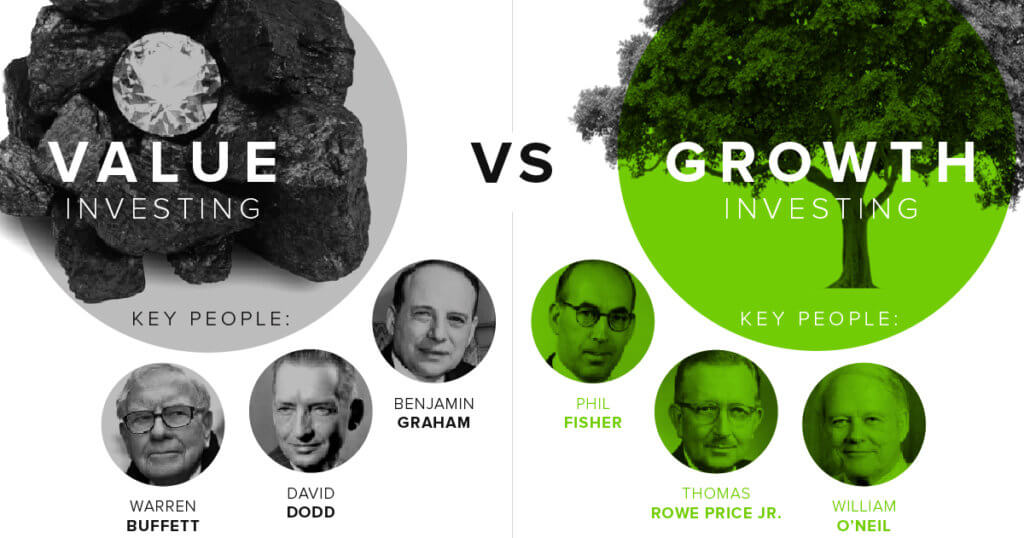
Image source: Visual Capitalist
In the traditional sense, value investing could be defined as buying a stock that is worth $1 today for 50 cents.
In the traditional sense, growth investing could be defined as buying something that is worth $1 today for $1.50 but it could be worth $6, five years from now.
Based on the Economic Times, growth investing is about finding companies that are expected to grow faster than the market while value investing is identifying companies whose stock prices are lower than their fundamental worth.
Why In My Definition, Value, and Growth Investing Essentially Has The Same Goal
Yes, growth stocks do not normally give out dividends and value stocks have the perception that they give out dividends more often. But value and growth investing have the same goal: which is to find the biggest opportunity or a gap or mispricing in relation to the business value at that point in time.
Both should simply be called “investing” or “business-focused or business-like investing”. Because both growth and value investing are business-focused investing in which an investor buys because they find that the price is cheap or reasonable in relation to what the true value of the business is.
There are more similarities in both the traditional senses of value investing and growth investing than we think.
Be it growth or value investing, like Warren Buffett said, “Your goal as an investor should simply be to purchase, at a rational price, a part interest in an easily understandable business whose earnings are virtually certain to be materially higher five, 10, and 20 years from now.”.
In Value or Growth Investing, Patience + Understanding of The Business is Key
In both value and growth investing, if we want to have big money, patience is one of the key ingredients for it. But again it really depends, a turnaround play can take less than 1 year to play out, on the other hand, asset play can take a few years or compounders – we may never want to sell it ever.
Ultimately, based on the type of company, we have to know which companies are worth paying a fair price or even a premium on.
“I don’t want to spend my time trying to earn a lot of little profits. I want very, very big profits that I’m ready to wait for.” – Philip Fisher
And hence, in both value and growth investing, we need to understand the business well enough to know at what price is good enough for us to buy it. So in the future, we have a reasonable probability of selling them at big profits (because we know their fair and overvalued range in relation to the price we bought them at).
I View The Categorization As We Are Either A Value or Growth Investor Limiting

Image source: Pixabay
If we view ourselves as a growth investor, then in the traditional sense, we will say no to value plays, asset plays, and turnaround plays for non-growth companies. And I find that limiting. Because in investing, we need to be flexible and adaptable as long as the opportunities are within our circle of competency, we should hit the big fat pitch that is right in front of us – no matter if it is growth or value plays.
So I propose us simply being an investor. A focused investor that is open to opportunities that we can understand be it in the traditional value plays or growth plays. Not saying no to the other simply because of our limiting categorization of ourselves either as a value or growth investor.
“Value investing, the way I regarded it, will never go out of style because value investing, the way I conceive it, is always wanting to get more value than you pay for when you buy a stock and that approach will never go out of style. Some people think that value investing is you chase companies that have a lot of cash and they’re in a lousy business or something. But I don’t define that as value investing. I think all good investing is value investing, and it’s just that some people look for values in strong companies and some look for values in weak companies, but every value investor tries to get more value than she pays for.” – Charlie Munger
So did Charlie just described value investing? or growth investing? My point is that it does not matter. All good investing should be the same – buying things for less than what we think will be worth in the future.
In Conclusion

Opportunities come from many angles.
A traditional value kind of investor should not overlook growth companies. A growth kind of investor should not overlook traditional value plays.
We should simply invest in anything that we understand and find mispricing in. Categorizing ourselves either as a growth or value investor in my view can be limiting.
I prefer to see myself simply as an investor, business-focused investing, or quality-focused investor.
Because in both the traditional kind of value or growth investing, we ultimately need to find quality in the play, and not speculate.
As long as I understand the business and it is run by great management, selling at a reasonable price compared to the business quality, I am open to investing in it – be it in the so-called value or growth companies. Because in my view, there is value in growth and there is also growth in value.
Based on Merrill, growth stocks tend to perform better when interest rates are falling and earnings are rising. But when economies are cooling, they are likely to be the first punished. While value stocks may do well early in an economic recovery but are typically more likely to lag in a sustained bull market.
Combining both value and growth strategies might give us the potential to gain throughout the economic cycles while staying within our circle of competence.
Even Fidelity suggests that we use a mix of growth and value strategies. They say it is akin to choosing between Batman and Superman. And I would agree. Why not do both?
Disclaimer:
The information provided is for educational and general information purposes only and is not intended to be personalized investment or financial advice. We make no promises as to the accuracy or usefulness of the information we present.
Important: Please read our full disclaimer.
Disclosure:
I/we have no positions in any stocks mentioned, and no plans to initiate any positions within the next 72 hours. I wrote this article myself, and it expresses my own opinions. I am not receiving compensation for it. I have no business relationship with any company whose stock is mentioned in this article.
Learned something from this article?
Share it 🙂

Chris Lee Susanto
Founder, investment blogger, full-time investor, and editor of this quality investing x business-like stock investing blog Re-ThinkWealth.com.
Chris is a big proponent of business-like stock investing – a mixture of both value and growth investing. He invests in companies where there is value to be found (as long as it is still within his circle of competence), be it a turnaround, depressed, value, or quality growth company (compounders). He either buys the stock outright or he profits through selling put or selling call options – or buying call options (buying and selling options are especially dangerous for those who do not know how to properly execute it).
Some of the places where Chris has been invited to speak or have added value as a mentor or writer includes Singapore Polytechnic, SMU Institute of Innovation and Entrepreneurship (IIE), Dollars and Sense, The New Savvy, Value Walk Blog, Investment Moats, NUS Tembusu College, NUS Investment Society, CGS-CIMB Singapore, Singapore Financial Conference by NTU IIC, The Financial Coconut Podcast, Money FM 89.3 and Internationally in Myanmar.
He is also a practitioner of Transcendental Meditation and Mindfulness practice. He also advocates regular exercise, enough sleep, and nutritious food as part of our lifestyle as an investor.
As of the time of this writing, Chris is focusing on setting up his MAS Licensed Fund with the goal to beat the market over the long run.
Feel free to join his FREE investment telegram channel here.
Don’t Leave First, Read Also:

Lessons from Ron Baron, The Long-Term Investor Billionaire
As value investors, a lot of us talk about investing for the long run. But what does investing in the long run really mean? As a value investor, I have had companies that I made over 50% in less than 6 months because that company I owned got acquired. I have also had companies […]

5 Investing Lessons from The Three Kingdom
Just finished rewatching all 95 episodes of The Romance of The Three Kingdoms – Although this is a classic Chinese historical war movie that is likely dramatized, there are a lot of lessons to be learned from it – for value investing purposes. [1] No matter how good we are or how much […]

How I Made 50% in 6 Months with Care.com
Today I want to share with you my thought processes when I first initiated a position in Care.com (NYSE: CRCM) on 28 May 2019 – and less than 6 months later on 20 December 2019 – overall at an average cost of $10.07, I sold off all of it at $15.05. My valuation for care was higher than […]
3 Actions to Make Best Use of Compound Interest
Compound interest is very powerful. It is the interest you get on top of the previous principal + interest you already got. Here are 3 actions you can take to make the best use of compound interest: Invest early – the earlier we invest, the more powerful the compounding effect […]

Peter Lynch One Up on Wall Street Summary | Ultimate Guide
Peter Lynch’s one up on wall street book was one of the first investing books that I read. I probably first read the book when I was about the age of 20 or 21, and now, after about five years in the market, I can tell you that the lessons hold. Who is Peter Lynch? Peter Lynch is a legendary […]

How To Start Investing in Stocks in Singapore For Beginners
This is a guide to help stock investing beginners to start their journey investing in stocks in Singapore or anywhere around the world. The purpose of this guide is to share with you some of the general mindsets, philosophies, guides – information that I […]

How Warren Buffett Use Put Options to Increase Berkshire’s Returns
You might know Warren Buffett from Berkshire Hathaway as a stock picker. But not many people know he has made a lot of money by selling put options. In this article, you will learn […]

Nasdaq & S&P 500 At A New High – Here’s What It Means
As of today, the Nasdaq & the S&P 500 has hit a new high. Recently, the US economy showed that GDP grew 2.1% annually in the second quarter of this year. It means that consumer is still […]

Get Wealthy Through Stocks (Value Investing Lessons from Pat Dorsey)
Warren Buffett’s definition of intrinsic value is “the discounted value of the cash that can be taken out of a business during its remaining life”. Now take a moment to pause and think about the above definition […]

Intrinsic Value of Stock: Here’s What It Means Based on Warren Buffett
Warren Buffett’s definition of intrinsic value is “the discounted value of the cash that can be taken out of a business during its remaining life”. Now take a moment to pause and think about the above definition […]

The Power of Compounding and Early Investing | RW Education Series
Albert Einstein says that compound interest is the eighth wonder of the world. He who understands it earns it and he doesn’t, pays it. Now, what exactly does Albert means by that? The power of compounding is amazing […]

What Are Treasury Bills/Bonds/Notes? | RW Education Series
Just like how companies take on debt from banks and pay interest to them in order to fund their operations, selling U.S. treasury bills/bonds/notes are one way the U.S. government raise funds to finance their […]