
Investing
The Power of Compounding and Early Investing | RW Education Series
Chris Lee Susanto, Founder at Re-ThinkWealth.com
20 June 2019

Understanding The Power of Compounding
Albert Einstein says that compound interest is the eighth wonder of the world. He who understands it earns it and he doesn’t, pays it.
Now, what exactly does Albert means by that?
The power of compounding is amazing. It is something that young people generally, in my opinion, cannot appreciate and older people wished they had utilized when they were younger.
The power of compounding means that when we start to invest earlier than others (for example in our 20s or 30s), we will earn much more than others by a certain period of time (say by the time we are in our 50s and 60s).
This is because of compound interest.
Compounding happens when the returns that we received from our investments, in turn, receive a return on them as well.
It is “interest paid on top of interest”.
Here’s Why Utilizing The Power of Compounding Comes From Early Investing
The earlier you invest, the more time your money will be able to utilize compounding to make more money for you.
And the best part? You will not break a sweat, same effort, more returns.
For example, if in the first year you invested $10,000 and you earn a 10% return on your investments in the first year, your account grows to $11,000 and you have made yourself $1,000.
If you keep this investment intact, earning the same return of 10% in the second year will get you not $1,000 of profit but $1,100 of profit because you get the 10% return from the $11,000 not the $10,000.
Same return %, same effort, more money.
Now imagine this snowball effect for decades down the road.
Here are a few case studies to showcase my point.
Case Study 1 – Investing Earlier + Investing Lesser Years > Investing Later + Investing More Years
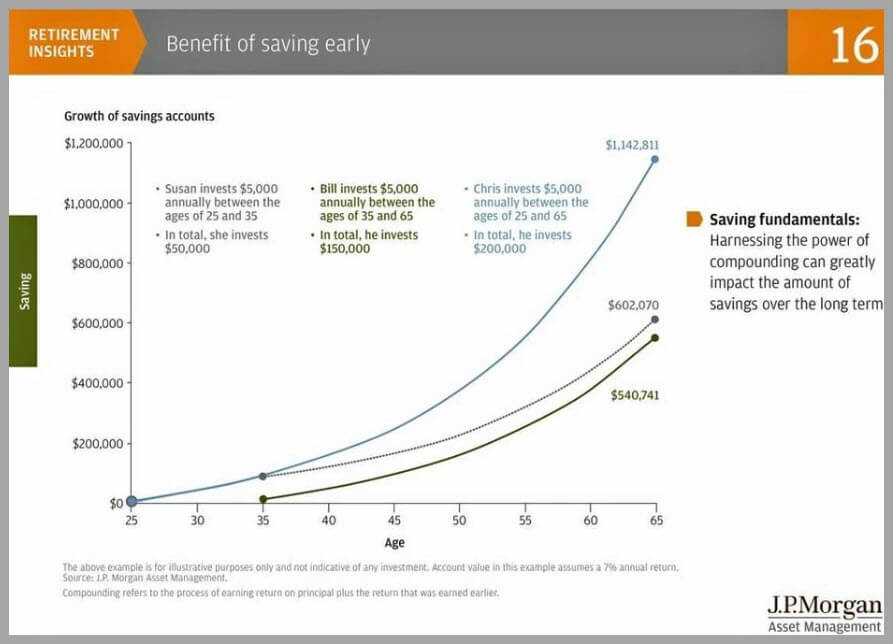
Source: JP Morgan
Susan who invested earlier ends up with more money than Bill at age 65 — even though Susan only invests for 10 years while Bill invests for 30 years.
The power of compounding.
Chris, on the other hand, is the best of the three (I am Chris too, good choice JP!).
Chris invested consistently throughout and is able to harness the full power of compound interest.
Case Study 2 – The Earlier One Start Investing, The Bigger The Compounding Effect Becomes

Source: Money Under 30
In the above example, there are three people — Michael, Jennifer, and Sam.
The example assumes a 7% rate of annual return for all 3 of them with the only difference being who started investing earlier.
So Michael started the earliest by saving $120,000 from age 25 to 35 and starting age 35, invested that $120,000. Then left the balance of $120,000 to accrue at 7% annual return until age 65 when he retired.
Jennifer only started saving at age 35 and only managed to save $120,000 by age 45 and started investing at that age. Then left the balance of $120,000 to accrue at 7% annual return until age 65.
Sam, on the other hand, invested $1,000 per month for 10 years, halted his savings at age 55 and left his money to accrue the investment return of 7% per year until the age of 65.
All three of them invested the same amount of capital of $120,000 but starting at different periods.
Michael ended with $1,444,969 which is more than double of Jennifer at $734,549 and almost five times of Sam ending balance at $373.407.
Summary – Use Compound Interest To Your Advantage, Start Investing Early
In summary, for young people, it is easy to not be keenly aware and take the necessary action to start increasing our earnings, savings and start investing early.
But the power of compounding and early investing is clear.
Albert Einstein says that compound interest is the eighth wonder of the world. He who understands it earns it and he doesn’t, pays it.
Albert is spot on.
Disclaimer:
The information provided is for general information purposes only and is not intended to be a personalized investment or financial advice.
Important: Please read our full disclaimer.
Read also now:
My Week 1 Summary of Yale University Financial Markets Course: Introduction and Principles of Finance
Recently I embarked on 8 weeks online course from Coursera.org that covers the basics of financial markets. It is taught by Professor Robert J. Shiller, an American Nobel Laureate and also a sterling professor of Economics Yale University. The course will run from the...
2 Key to be SUCCESSFUL in VALUE INVESTING
As the saying goes, "Many roads lead to Rome." The same with value investing, there are many key aspects you can focus on in choosing to buy an undervalued stock. Here is two key to be successful in value investing: Company’s earnings power and whether the stock is...
Sold January 2016 put for KERYX
Today i sold January 2016 Put option for Keryx Bio-pharmaceuticals Current Implied Volatility= 98% Margin of safety for stock to fall before being exercised= 30% Strike price=4 USD Premium per contract= 13 USD Commission= 1.4 USD Return in 44 days time=...
Re-examining GameStop as a cigar butt stock investing opportunity
Clearly, GameStop management is aiming to reduce reliance on selling video games and pre-owned games by reducing the store counts for this two — while increasing the store counts (as you can see from the chart above) for Collectibles and Technology business (which is currently still at 5.7% and 9.5% of their overall revenue). I think that it is a step in the right direction as even though the collectibles and technology business only accounts for 15.2% of GameStop’s revenue for 2016, it accounted for 36.9% of GameStop’s total […]

Valuation Ratios – The Basics
[…] Not a true cash flow as it excludes CAPEX and working capital. D&A may be added back to net income when calculating cash flows, however, this implicitly assumes that no additional CAPEX is required. A more refined multiple is EV/(EBITDA – CAPEX), though no news source reports this […]

Determining Value: Why Price Is Meaningless, and Multiples are Informative
Investing Lessons [Advanced] Determining Value: Why Price Is Meaningless, and Multiples are Informative Bryan Wang, Re-ThinkWealth Content Expert 23 September 2017 One of the typical responses people give when talking about stocks is..."What's the price?" In the...

10 Mistakes an Investor should Avoid
Investing Lessons [Beginners] 10 Mistakes an Investor should Avoid Benjamin Tan, Content Expert, Re-ThinkWealth 1 September 2017 Every investor has their own investment philosophy and discipline. Each philosophy has its own merit and what is important...
Value Investing And Behavioral Finance
Investing Lessons [Advanced] Value Investing And Behavioral Finance Chris Lee Susanto, Founder and CEO of Re-ThinkWealth 15 July 2017 SUMMARY: Value Investing is inevitably linked to Behavioural Finance Value Investing is a stock methodology practised by many...
![Options Selling Strategy – Wk 4 June 2017 [Keryx Pharmaceuticals (NASDAQ: KERX)]](https://www.re-thinkwealth.com/wp-content/uploads/2017/06/Options-Seliing.jpg)
Options Selling Strategy – Wk 4 June 2017 [Keryx Pharmaceuticals (NASDAQ: KERX)]
Options Selling Options Selling Strategy – Wk 4 June 2017 [Keryx Pharmaceuticals (NASDAQ: KERX)] Chris Lee Susanto, Founder and CEO, Re-ThinkWealth 24 June 2017 SUMMARY: Options are a form of financial derivatives Options selling strategy have...

Options Selling Strategy – Wk 3 June 2017 (GameStop Inc (NYSE: GME)
Options Selling Options Selling Strategy – Wk 3 June 2017 (GameStop Inc (NYSE: GME) Chris Lee Susanto, Founder and CEO, Re-ThinkWealth 16 June 2017 SUMMARY: Options are a form of financial derivatives Options selling strategy have stocks as...

GameStop Corp (NYSE: GME)– A Cigar Butt Investing Play
Top Articles GameStop Corp (NYSE: GME)– A Cigar Butt Investing Play Chris Lee Susanto, Founder and CEO, Re-ThinkWealth 12 May 2017 SUMMARY: GameStop's valuation is at an all-time low Gross profit margins have been doing well Debt management is good I...
