Investing
What Are U.S. Treasury Bills/Bonds/Notes? | RW Education Series
Chris Lee Susanto, Founder at Re-ThinkWealth.com
15 June 2019

What Are U.S. Treasury Bills/Bonds/Notes?
Just like how companies take on debt from banks and pay interest to them in order to fund their operations, selling U.S. treasury bills/bonds/notes are one way the U.S. government raise funds to finance their operations.
Treasury bills/bonds/notes would come under the fixed income investment category and the three of them generally have a different time to maturity:
- Treasury bills usually mature in a year or less
- Treasury notes usually mature in two to ten years time
- Treasury bonds usually mature in ten to thirty years time
Based on Investopedia, the U.S. treasury department said that the selling of these “national debt” dates back to the revolutionary war. The first U.S. treasury bills were sold in 1929.
Essentially, when one buys U.S. treasury bills/bonds/notes, we are lending money to the U.S. government and they give us interest for it. The bills are usually sold at a discount from the face value and we get the full amount when the bill matures. Notes and bonds are usually sold at face value with a fixed interest rate once every six months. We can buy them in an increment of $1,000.
The U.S. treasury bills and notes can be bought and sold in the market except for the bonds which are tied to one owner.
U.S. treasury bills, bonds, and notes can be purchased online through the TreasuryDirect.gov website or you can also check with your bank or broker on how to get them if you are interested.
“Treasury Bills/Bonds/Notes” in Singapore
In Singapore, based on SGS.GOV we have the Singapore Government Securities (SGS) bonds and T-bills. They are both the Singapore version of debt instrument used by the Government of Singapore.
Just like the U.S. treasury bills/bonds/notes which are backed by the government, the SGS bonds and T-bills are also backed by the government — the Singapore government.
Based on SGS.GOV website, it says that the Singapore Government is obliged to pay the holders a fixed sum of money on the maturity date of these securities. Which means that the investors will buy it below face value and upon maturity, get the face value.
Both the SGS bonds and T-bills cannot be cashed in before their maturity dates but investors can sell them in secondary markets by SGS primary dealers.
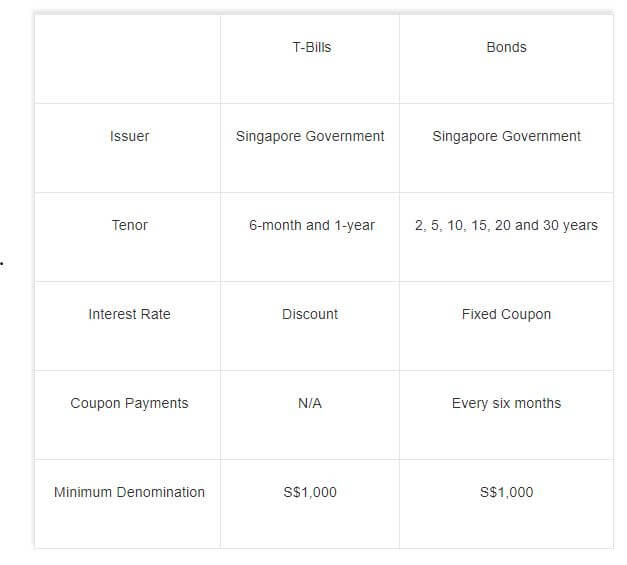
Source: SGS.GOV.SG
The above shows the summary table on SGS bonds and T-bills.
Of course, in Singapore, we also have the popular SGS bond known as the SSB or also known as Singapore Savings Bonds. The SSB is a type of SGS (Singapore Government Securities).
You can learn more about the Singapore Savings Bonds here.
If one is interested, here is how they can purchase SGS bonds/T-bills:
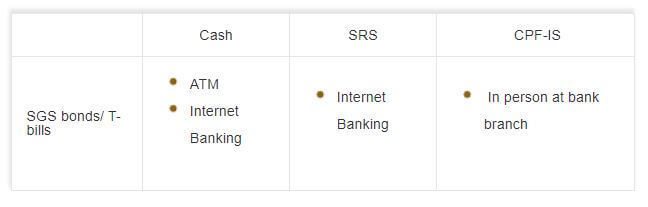
Source: SGS.GOV.SG
You may also call our respective banks, DBS, UOB or OCBC if you’d like to get more detailed instructions and pieces of information on SGS bonds/T-bills.
How It May Fit One’s Portfolio
My opinion is that since these securities are backed by the respective government, it is definitely in the “less risky” category as compared to other investment choices like for example, stocks.
The returns for these government bills/bonds/notes are also naturally lower and would come under the fixed income investment category.
For a value investor, on the other hand, these bills/bonds/notes can be considered as a “temporary cash parking space” if we have not found any good idea in the stock market to park our cash into.
For example, Warren Buffett cash of over $100 billion is used to buy plenty of T-Bills because he has not found any good value opportunities to deploy the cash yet in the stock market.
A Yahoo Finance article also stated that Warren prefers T-Bills to index funds like the S&P500 in terms of parking its money is because it will be easier for him to deploy the cash with it parked in the liquid short term T-Bills — while waiting for opportunistic deals which can be unpredictable in nature.
In Summary
I have come to value the flexibility that cash gives me in terms of its ability to pounce on opportunities quickly and decisively.
But the fact remains that cash is an asset that is unproductive in nature and one that is constantly being “attacked” by inflation. So the availability of government-backed securities option with varying time to maturity and its ability to be sold on secondary markets is definitely an advantage to take advantage of — if the need arises.
Disclaimer:
The information provided is for general information purposes only and is not intended to be a personalized investment or financial advice.
Important: Please read our full disclaimer.
Read also now:
No Results Found
The page you requested could not be found. Try refining your search, or use the navigation above to locate the post.

My Stock Update: Keppel DC REIT Q2 DPU up 3.1%– Will I Sell?
What Keppel DC REIT Do Keppel DC REIT (SGX: AJBU) is a Singapore-based real estate investment trust (REIT). It was established with the main investment strategy of investing in a portfolio of income-producing real estate assets. They are primarily used for data centre...
Mr. Lim Say Boon, Chief Investment Officer of DBS Wealth Management’s 8 Predictions for The 2nd Half 2016 Market Outlook
This is what I have gathered from Mr Lim Say Boon, Chief Investment Officer of DBS Wealth Management's 8 predictions for the 2nd half 2016 market outlook: Brexit will not break EU but will break European stocks Global economy will continue to suffer and corporate...

Valuing Mobile Telesystems (NYSE: MBT) Using H Dividend Discount Model
Summary MBT is a telecommunications company with more than 100,000,000 subscribers and is Russia’s largest mobile operator and has high payout ratio close to their Free Cash Flow-- which warrant the use of dividend discount model (DDM) to value it H Dividend Discount...

Keryx Biopharmaceuticals Went Up 11.87% On 2 June 2016– BUT Should It?
Keryx Biopharmaceuticals (NASDAQ: KERX) As Part Of My Portfolio KERX is one of the more interesting stock in my portfolio-- and it is also a growth stock that has the potential to be a multi-bagger. What is a multi-bagger? "A multibagger is an investment that has...

Here Is What I Learnt From Watching Money Monster
I am a fan of George Clooney. The latest movie that he acted in is called Money Monster. This article aims to share what I have learnt from watching the movie-- from the perspective of someone who love investing. Before I share with you the lessons that I learnt, I...
#FAQ What To Take Note When Using Past Returns To Estimate Future Returns Of Stocks
Past Equal To Future? We have to take note that since expected returns we expect to receive from a stock investment is based on assumptions using past returns, we are basing the assumption that the past would equal to the future. This assumption would not be relevant...

Addition to My Family Portfolio- A Biotechnology ETF!
One of the first stock that I bought was called iShares Nasdaq Biotechnology ETF (NASDAQ: IBB). I bought it on 5th February 2015 at $310.51 and sold it on 13th July 2015 at $380, netting a cool 21.39%. I like biotechnology stock and so far I have had good experience...

7 Offline Channels For Leads And Their Real Cost
7 Offline Channels for leads and their real cost So much ado has been made about leads and their real cost. But what are the channels that you, the business owner or salesperson, can use to get more leads? The role of face-to-face event prospecting is in the business...