Investing
What Are U.S. Treasury Bills/Bonds/Notes? | RW Education Series
Chris Lee Susanto, Founder at Re-ThinkWealth.com
15 June 2019

What Are U.S. Treasury Bills/Bonds/Notes?
Just like how companies take on debt from banks and pay interest to them in order to fund their operations, selling U.S. treasury bills/bonds/notes are one way the U.S. government raise funds to finance their operations.
Treasury bills/bonds/notes would come under the fixed income investment category and the three of them generally have a different time to maturity:
- Treasury bills usually mature in a year or less
- Treasury notes usually mature in two to ten years time
- Treasury bonds usually mature in ten to thirty years time
Based on Investopedia, the U.S. treasury department said that the selling of these “national debt” dates back to the revolutionary war. The first U.S. treasury bills were sold in 1929.
Essentially, when one buys U.S. treasury bills/bonds/notes, we are lending money to the U.S. government and they give us interest for it. The bills are usually sold at a discount from the face value and we get the full amount when the bill matures. Notes and bonds are usually sold at face value with a fixed interest rate once every six months. We can buy them in an increment of $1,000.
The U.S. treasury bills and notes can be bought and sold in the market except for the bonds which are tied to one owner.
U.S. treasury bills, bonds, and notes can be purchased online through the TreasuryDirect.gov website or you can also check with your bank or broker on how to get them if you are interested.
“Treasury Bills/Bonds/Notes” in Singapore
In Singapore, based on SGS.GOV we have the Singapore Government Securities (SGS) bonds and T-bills. They are both the Singapore version of debt instrument used by the Government of Singapore.
Just like the U.S. treasury bills/bonds/notes which are backed by the government, the SGS bonds and T-bills are also backed by the government — the Singapore government.
Based on SGS.GOV website, it says that the Singapore Government is obliged to pay the holders a fixed sum of money on the maturity date of these securities. Which means that the investors will buy it below face value and upon maturity, get the face value.
Both the SGS bonds and T-bills cannot be cashed in before their maturity dates but investors can sell them in secondary markets by SGS primary dealers.
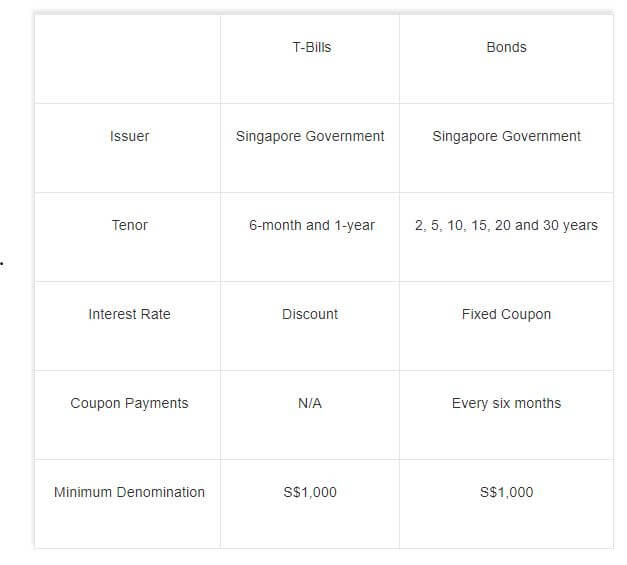
Source: SGS.GOV.SG
The above shows the summary table on SGS bonds and T-bills.
Of course, in Singapore, we also have the popular SGS bond known as the SSB or also known as Singapore Savings Bonds. The SSB is a type of SGS (Singapore Government Securities).
You can learn more about the Singapore Savings Bonds here.
If one is interested, here is how they can purchase SGS bonds/T-bills:
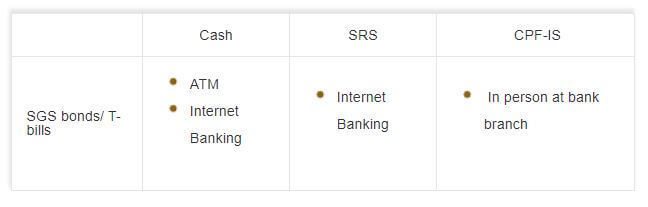
Source: SGS.GOV.SG
You may also call our respective banks, DBS, UOB or OCBC if you’d like to get more detailed instructions and pieces of information on SGS bonds/T-bills.
How It May Fit One’s Portfolio
My opinion is that since these securities are backed by the respective government, it is definitely in the “less risky” category as compared to other investment choices like for example, stocks.
The returns for these government bills/bonds/notes are also naturally lower and would come under the fixed income investment category.
For a value investor, on the other hand, these bills/bonds/notes can be considered as a “temporary cash parking space” if we have not found any good idea in the stock market to park our cash into.
For example, Warren Buffett cash of over $100 billion is used to buy plenty of T-Bills because he has not found any good value opportunities to deploy the cash yet in the stock market.
A Yahoo Finance article also stated that Warren prefers T-Bills to index funds like the S&P500 in terms of parking its money is because it will be easier for him to deploy the cash with it parked in the liquid short term T-Bills — while waiting for opportunistic deals which can be unpredictable in nature.
In Summary
I have come to value the flexibility that cash gives me in terms of its ability to pounce on opportunities quickly and decisively.
But the fact remains that cash is an asset that is unproductive in nature and one that is constantly being “attacked” by inflation. So the availability of government-backed securities option with varying time to maturity and its ability to be sold on secondary markets is definitely an advantage to take advantage of — if the need arises.
Disclaimer:
The information provided is for general information purposes only and is not intended to be a personalized investment or financial advice.
Important: Please read our full disclaimer.
Read also now:
No Results Found
The page you requested could not be found. Try refining your search, or use the navigation above to locate the post.
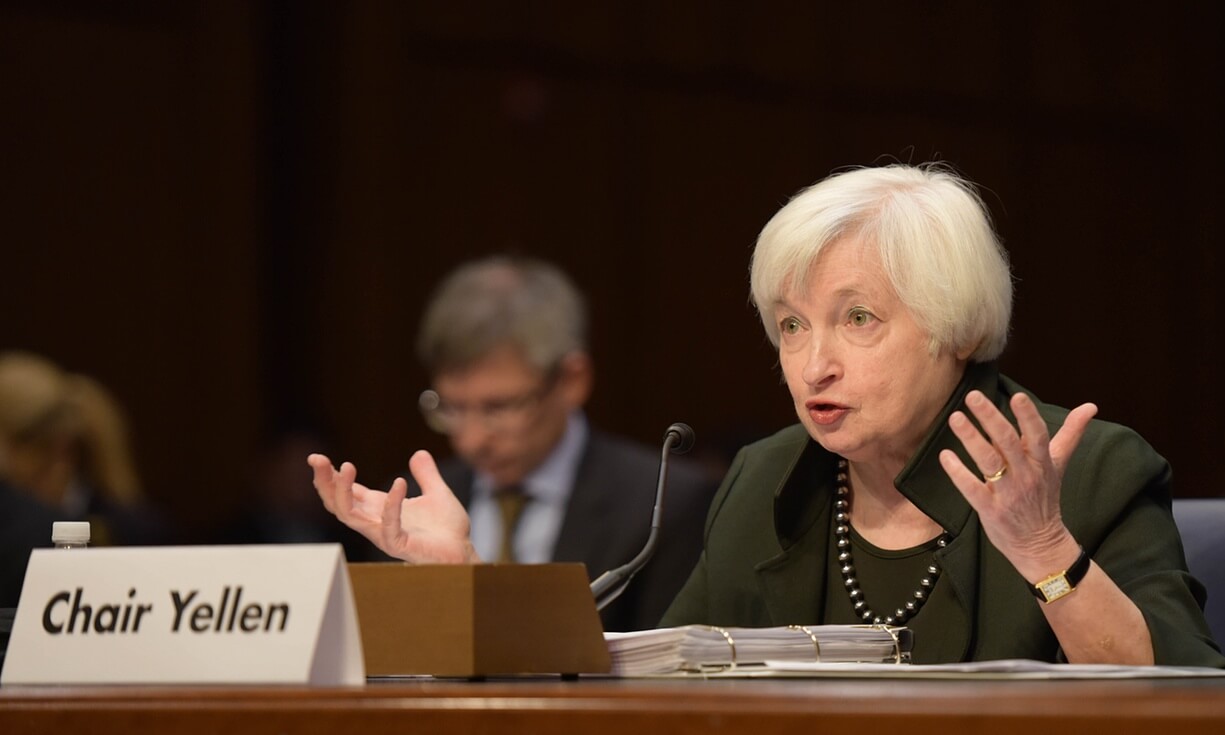
Will The Fed Finally Raise Interest Rate on 16 Dec 2015?
The expectation was based on Chair Janet Yellen's oft-repeated stance that she'd like to see rate rises before the end of 2015. The last time the United States Federal Reserve raised their interest rates was back in 2006, a decade ago. With shares and commodity...
Here Is Everything You Need To Know About The Singapore Savings Bonds
What Are Bonds Bonds are one of the methods for corporations and governments to raise funds. It is a form of borrowing whereby we lend money to the government or corporations and we earn interest on it. We are able to redeem the principal amount but normally there is...

Seven Steps For Starting A Conversation
The seven steps for starting a conversation at a party Give a sincere smile and say Hello Provide a short introduction of who you are and give a firm handshake Listen closely to the person's name - Ask them to repeat it if you did not hear it clearly the first time...

My Week 2 Summary of Yale University Financial Markets Course: The History and Real Impact of Behavioral Finance
The History and The Real Impact of Behavioural Finance People are complex and our financial institutions are designed for real people. This study of behavioural finance started because of the revolution of neuroscience and the fact that the human brain is a...
My Week 1 Summary of Yale University Financial Markets Course: Introduction and Principles of Finance
Recently I embarked on 8 weeks online course from Coursera.org that covers the basics of financial markets. It is taught by Professor Robert J. Shiller, an American Nobel Laureate and also a sterling professor of Economics Yale University. The course will run from the...

2 Key to be SUCCESSFUL in VALUE INVESTING
As the saying goes, "Many roads lead to Rome." The same with value investing, there are many key aspects you can focus on in choosing to buy an undervalued stock. Here is two key to be successful in value investing: Company’s earnings power and whether the stock is...
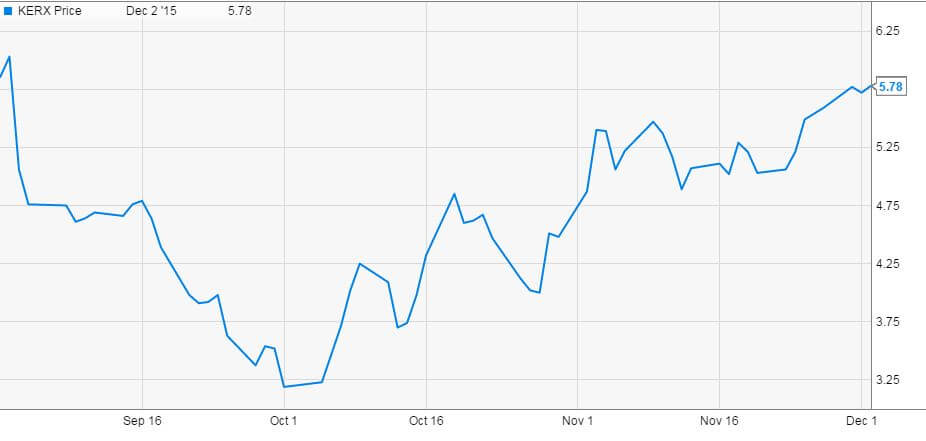
Sold January 2016 put for KERYX
Today i sold January 2016 Put option for Keryx Bio-pharmaceuticals Current Implied Volatility= 98% Margin of safety for stock to fall before being exercised= 30% Strike price=4 USD Premium per contract= 13 USD Commission= 1.4 USD Return in 44 days time=...