Investing
What Are U.S. Treasury Bills/Bonds/Notes? | RW Education Series
Chris Lee Susanto, Founder at Re-ThinkWealth.com
15 June 2019

What Are U.S. Treasury Bills/Bonds/Notes?
Just like how companies take on debt from banks and pay interest to them in order to fund their operations, selling U.S. treasury bills/bonds/notes are one way the U.S. government raise funds to finance their operations.
Treasury bills/bonds/notes would come under the fixed income investment category and the three of them generally have a different time to maturity:
- Treasury bills usually mature in a year or less
- Treasury notes usually mature in two to ten years time
- Treasury bonds usually mature in ten to thirty years time
Based on Investopedia, the U.S. treasury department said that the selling of these “national debt” dates back to the revolutionary war. The first U.S. treasury bills were sold in 1929.
Essentially, when one buys U.S. treasury bills/bonds/notes, we are lending money to the U.S. government and they give us interest for it. The bills are usually sold at a discount from the face value and we get the full amount when the bill matures. Notes and bonds are usually sold at face value with a fixed interest rate once every six months. We can buy them in an increment of $1,000.
The U.S. treasury bills and notes can be bought and sold in the market except for the bonds which are tied to one owner.
U.S. treasury bills, bonds, and notes can be purchased online through the TreasuryDirect.gov website or you can also check with your bank or broker on how to get them if you are interested.
“Treasury Bills/Bonds/Notes” in Singapore
In Singapore, based on SGS.GOV we have the Singapore Government Securities (SGS) bonds and T-bills. They are both the Singapore version of debt instrument used by the Government of Singapore.
Just like the U.S. treasury bills/bonds/notes which are backed by the government, the SGS bonds and T-bills are also backed by the government — the Singapore government.
Based on SGS.GOV website, it says that the Singapore Government is obliged to pay the holders a fixed sum of money on the maturity date of these securities. Which means that the investors will buy it below face value and upon maturity, get the face value.
Both the SGS bonds and T-bills cannot be cashed in before their maturity dates but investors can sell them in secondary markets by SGS primary dealers.
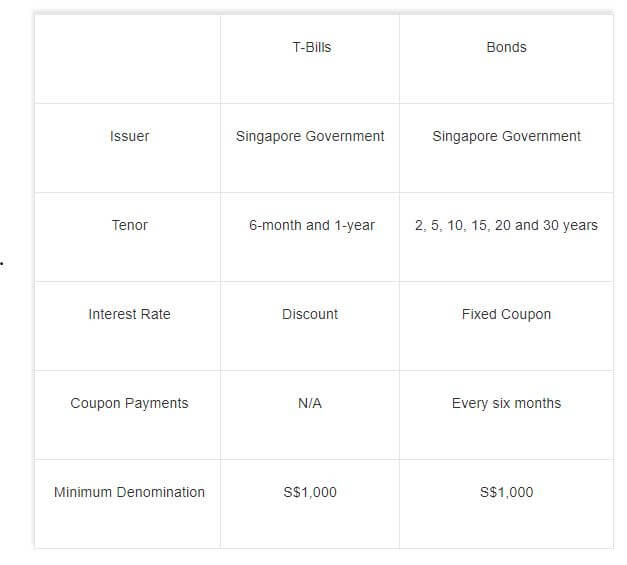
Source: SGS.GOV.SG
The above shows the summary table on SGS bonds and T-bills.
Of course, in Singapore, we also have the popular SGS bond known as the SSB or also known as Singapore Savings Bonds. The SSB is a type of SGS (Singapore Government Securities).
You can learn more about the Singapore Savings Bonds here.
If one is interested, here is how they can purchase SGS bonds/T-bills:
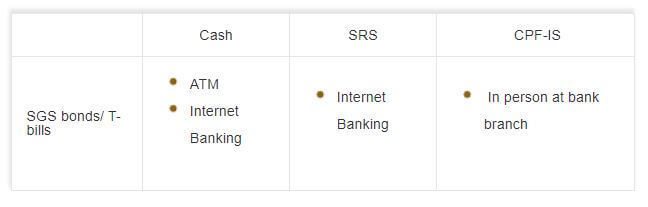
Source: SGS.GOV.SG
You may also call our respective banks, DBS, UOB or OCBC if you’d like to get more detailed instructions and pieces of information on SGS bonds/T-bills.
How It May Fit One’s Portfolio
My opinion is that since these securities are backed by the respective government, it is definitely in the “less risky” category as compared to other investment choices like for example, stocks.
The returns for these government bills/bonds/notes are also naturally lower and would come under the fixed income investment category.
For a value investor, on the other hand, these bills/bonds/notes can be considered as a “temporary cash parking space” if we have not found any good idea in the stock market to park our cash into.
For example, Warren Buffett cash of over $100 billion is used to buy plenty of T-Bills because he has not found any good value opportunities to deploy the cash yet in the stock market.
A Yahoo Finance article also stated that Warren prefers T-Bills to index funds like the S&P500 in terms of parking its money is because it will be easier for him to deploy the cash with it parked in the liquid short term T-Bills — while waiting for opportunistic deals which can be unpredictable in nature.
In Summary
I have come to value the flexibility that cash gives me in terms of its ability to pounce on opportunities quickly and decisively.
But the fact remains that cash is an asset that is unproductive in nature and one that is constantly being “attacked” by inflation. So the availability of government-backed securities option with varying time to maturity and its ability to be sold on secondary markets is definitely an advantage to take advantage of — if the need arises.
Disclaimer:
The information provided is for general information purposes only and is not intended to be a personalized investment or financial advice.
Important: Please read our full disclaimer.
Read also now:
7 Key Investing Lessons from Charlie Munger & Li Lu Interview
I chanced upon an edited transcripts from Guru Focus of an interview of Munger and Li Lu in one of China’s top finance magazines. Here are the 7 investing lessons I learned from Charlie Munger and Li Lu’s interview: 1. In investing, patience is very […]
Lessons from Ron Baron, The Long-Term Investor Billionaire
As value investors, a lot of us talk about investing for the long run. But what does investing in the long run really mean? As a value investor, I have had companies that I made over 50% in less than 6 months because that company I owned got acquired. I have also had companies […]
5 Investing Lessons from The Three Kingdom
Just finished rewatching all 95 episodes of The Romance of The Three Kingdoms – Although this is a classic Chinese historical war movie that is likely dramatized, there are a lot of lessons to be learned from it – for value investing purposes. [1] No matter how good we are or how much […]
How I Made 50% in 6 Months with Care.com
Today I want to share with you my thought processes when I first initiated a position in Care.com (NYSE: CRCM) on 28 May 2019 – and less than 6 months later on 20 December 2019 – overall at an average cost of $10.07, I sold off all of it at $15.05. My valuation for care was higher than […]
3 Actions to Make Best Use of Compound Interest
Compound interest is very powerful. It is the interest you get on top of the previous principal + interest you already got. Here are 3 actions you can take to make the best use of compound interest: Invest early – the earlier we invest, the more powerful the compounding effect […]
Peter Lynch One Up on Wall Street Summary | Ultimate Guide
Peter Lynch’s one up on wall street book was one of the first investing books that I read. I probably first read the book when I was about the age of 20 or 21, and now, after about five years in the market, I can tell you that the lessons hold. Who is Peter Lynch? Peter Lynch is a legendary […]
How To Start Investing in Stocks in Singapore For Beginners
This is a guide to help stock investing beginners to start their journey investing in stocks in Singapore or anywhere around the world. The purpose of this guide is to share with you some of the general mindsets, philosophies, guides – information that I […]
How Warren Buffett Use Put Options to Increase Berkshire’s Returns
You might know Warren Buffett from Berkshire Hathaway as a stock picker. But not many people know he has made a lot of money by selling put options. In this article, you will learn […]
Nasdaq & S&P 500 At A New High – Here’s What It Means
As of today, the Nasdaq & the S&P 500 has hit a new high. Recently, the US economy showed that GDP grew 2.1% annually in the second quarter of this year. It means that consumer is still […]
Get Wealthy Through Stocks (Value Investing Lessons from Pat Dorsey)
Warren Buffett’s definition of intrinsic value is “the discounted value of the cash that can be taken out of a business during its remaining life”. Now take a moment to pause and think about the above definition […]
Intrinsic Value of Stock: Here’s What It Means Based on Warren Buffett
Warren Buffett’s definition of intrinsic value is “the discounted value of the cash that can be taken out of a business during its remaining life”. Now take a moment to pause and think about the above definition […]
The Power of Compounding and Early Investing | RW Education Series
Albert Einstein says that compound interest is the eighth wonder of the world. He who understands it earns it and he doesn’t, pays it. Now, what exactly does Albert means by that? The power of compounding is amazing […]

Is Bitcoin Worth Investing in 2020? Here’s My Quick Thoughts
Bitcoin can be considered the world’s best-known cryptocurrency. Today is the 21st of November, 2020 and coincidentally, Bitcoin supply is also […]

Is Oculus Owned by Facebook? Yes And Here’s Why It’s Great
I have been wanting to buy the Oculus Quest for the longest time. A few years ago, when Oculus first came out with The Oculus Quest, I wanted to […]

Election Results: Biden or Trump? Here’s Why To The Stock Market, It Doesn’t Matter
Based on the current trend of the mail-in ballots, it seems likely that Biden is going to be the victor of the US election in

Why Netflix Raised The Price of It’s U.S. Subscription And Is It A Mistake?
Netflix currently has more than 65 million U.S. subscribers and about 195 million paid […] Their last hike for the U.S. price was in January 2019.

The Ultimate List of Investment and Finance Blogs/Websites in Singapore
Being an avid follower of many investment and finance blogs or websites in Singapore, I thought why not I create an

My 5 Key Takeaways From SPH FY2020’s Earnings
1. Long-Term Challenge With Media Division The first thing that comes to mind when we hear SPH is the newspaper. And newspaper makes money through […]

8 Value Investing Lessons From Beating The S&P 500 Return So Far
There are many value investing lessons that I have learned throughout these past five, six years. For today, I thought to share with you eight of the value investing lessons […]

Here Are My Five Key Takeaway From Tesla 2020 Battery Day
Elon Musk is a fantastic marketer and an innovative entrepreneur. I have been curious about the Tesla story for quite some time. And here are my five key takeaway from Tesla 2020 […]