Investing
What I Learnt From Adam Smith About Investment and Money
Chris Susanto
18 July 2020
Who is Adam Smith?
Adam Smith (1723-1790) was a philosopher and economist who was best known for authoring the book An Inquiry into the Nature and Causes of the Wealth of Nations. Wealth of Nations also happens to be one of Warren Buffett’s favourite books.
See also: Our free investing telegram channel. We post daily.
What I Learnt From Adam Smith About Investment and Money
1. Professional investors are deemed to be smarter because they can churn out ratios at the touch of a button compared to the small investor. They are in fact, not smarter, they merely have more information
It is true that the pros have more resources at hand to subscribe to Bloomberg Terminal for example which cost a bomb. And they are deemed to be smarter.
But the truth is having more resources and information may not always result in better investment performance. Because investment performance is also a lot about managing our emotions.
2. To be a good investor, you have to be a good brain picker and brain pickers are usually good for a dinner conversation
Hence the saying too, it is not just what you know, but who you know.
This does not mean that we should ask for stock tips.
I think that what Adam might be saying here is that we should leverage on people’s views on some stocks he or she might be looking at.
It is ultimately left to our judgment, analysis, and valuation on whether the stock is worth investing or not.
3. The safest way to preserve capital is to double it
I believe in this insight of him. It is indeed the safest way because if we manage to double our money, we can withstand more draw-down and still preserve our capital.
4. The stock does not know that you own it
This is one of my favorite ones. Recently I talked to a friend, an ex MD of UBS. Even a man of his experience would agree with me that people (including myself) anchor the stock to the price we bought it at. But hey, the stock does not even know that we own it. And at what price. But humans are often very emotional about stocks and anchor them to the price we bought it at.
In the end, what matters is the value of the business, not the daily stock price movement. So in a sense, the price is meaningless, our value of it – and whether we are right or wrong is.
5. 80% of the market game is psychology
I agree. That is why I named my blog re-thinkwealth. It is to remind us to rethink our assumptions and logic. And to remind me as well that ultimately the name of the game is having good emotional control as well as a rational mind.
6. If you do not know who you are, the market is a terribly expensive place to find out
I agree. The stock market often rattles people because [1] they follow people blindly and do not understand what they are doing [2] they forgot that investing in the stock market is a combination of good emotional control as well as having a rational mind.
Disclaimer:
The information provided is for general information purposes only and is not intended to be a personalized investment or financial advice.
Important: Please read our full disclaimer.

Chris Lee Susanto
Founder of the value investing blog Re-ThinkWealth.com (if you type “value investing blog” in Google, his blog is likely the first one). Being a full-time investor himself, Chris knows that he did not beat the S&P 500 return so far (as of the time of this writing) by listening to stock tips. So, when he teaches, he also doesn’t believe in giving stock tips as it is not sustainable for you in the long run. He will teach you how to make your own intelligent decisions with his 4M1S framework. Feel free to also join his free investment telegram channel here.
Read also now:
Kodak Stock is Up Over 1,400% in Two Days. Does It Make Sense?
Eastman Kodak Company (NYSE: KODK) opened at $2.15 (Monday) on July 27, 2020, and closed at $33.20 (Wednesday) by 29 July 2020. That is a 1,444.19% increase over a two day period. In this article, I am going to give you some background on the Kodak company, the reason […]
Here Are 4 Reasons Why Intel Stock Plunged 16% Last Friday
Last Friday on 24 July 2020, Intel closed 16.24% down. Although I do not own any Intel stock, I was curious why it fell after releasing its Q2 2020 results. Just a while ago, I saw the news that after 15 years of partnership, Apple decided to break up with Intel and stop using its […]

My 5 Key Takeaway From Temasek Portfolio Value in 2020
1. Temasek Portfolio is Huge. Although I know that Temasek has a huge portfolio, I was surprised to see that it is around the size of Warren Buffett’s. As of 31 March 2020, the net portfolio value or NPV is at S$306 billion. So we have our own Warren Buffett in Singapore, that is […]

A List of Value Investing Funds in Singapore and Outside of Singapore
As a value investor, as a practitioner of value investing, I am very interested in studying funds I view as an executioner of the various value investing methodologies I myself am very passionate about. In this article, I will list down some of the value investing funds in […]

Protected: My Gratitude Journal as An Investor (And The Benefits of It)
There is no excerpt because this is a protected post.
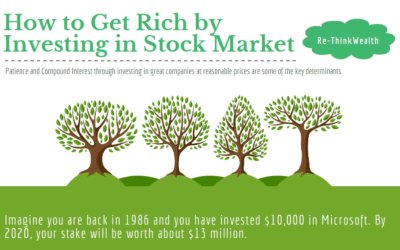
How to Get Rich by Investing in Stock Market? Patience
How do people get rich by investing in stocks? Can we actually get rich by investing in stocks? Yes, we can. But we need to utilize both Patience and Compound Interest in Great Companies. With the proper foundation, framework, character, and skills, I truly believe that […]

Here’s What Sun Tzu Art of War Quotes Can Teach Us About Investing
Sun Tzu Art of War Quotes “He will win who knows when to fight and when not to fight” – We should only invest when there is clear benefit to do so, do not do something just for the sake of doing something. “If you know the enemy and know yourself, you need not fear […]
Thinking, Fast and Slow Book Summary (What I Learnt As An Investor)
In this thinking fast and slow book summary, I will explain to you the various human biases that we have and why it is important for us as investors to understand it. It all begins with a simple premise that we all have two systems in our brain, system 1 and system 2 […]
7 Key Investing Lessons from Charlie Munger & Li Lu Interview
I chanced upon an edited transcripts from Guru Focus of an interview of Munger and Li Lu in one of China’s top finance magazines. Here are the 7 investing lessons I learned from Charlie Munger and Li Lu’s interview: 1. In investing, patience is very […]

Lessons from Ron Baron, The Long-Term Investor Billionaire
As value investors, a lot of us talk about investing for the long run. But what does investing in the long run really mean? As a value investor, I have had companies that I made over 50% in less than 6 months because that company I owned got acquired. I have also had companies […]

5 Investing Lessons from The Three Kingdom
Just finished rewatching all 95 episodes of The Romance of The Three Kingdoms – Although this is a classic Chinese historical war movie that is likely dramatized, there are a lot of lessons to be learned from it – for value investing purposes. [1] No matter how good we are or how much […]

How I Made 50% in 6 Months with Care.com
Today I want to share with you my thought processes when I first initiated a position in Care.com (NYSE: CRCM) on 28 May 2019 – and less than 6 months later on 20 December 2019 – overall at an average cost of $10.07, I sold off all of it at $15.05. My valuation for care was higher than […]
3 Actions to Make Best Use of Compound Interest
Compound interest is very powerful. It is the interest you get on top of the previous principal + interest you already got. Here are 3 actions you can take to make the best use of compound interest: Invest early – the earlier we invest, the more powerful the compounding effect […]

Peter Lynch One Up on Wall Street Summary | Ultimate Guide
Peter Lynch’s one up on wall street book was one of the first investing books that I read. I probably first read the book when I was about the age of 20 or 21, and now, after about five years in the market, I can tell you that the lessons hold. Who is Peter Lynch? Peter Lynch is a legendary […]

How To Start Investing in Stocks in Singapore For Beginners
This is a guide to help stock investing beginners to start their journey investing in stocks in Singapore or anywhere around the world. The purpose of this guide is to share with you some of the general mindsets, philosophies, guides – information that I […]

How Warren Buffett Use Put Options to Increase Berkshire’s Returns
You might know Warren Buffett from Berkshire Hathaway as a stock picker. But not many people know he has made a lot of money by selling put options. In this article, you will learn […]

Nasdaq & S&P 500 At A New High – Here’s What It Means
As of today, the Nasdaq & the S&P 500 has hit a new high. Recently, the US economy showed that GDP grew 2.1% annually in the second quarter of this year. It means that consumer is still […]

Get Wealthy Through Stocks (Value Investing Lessons from Pat Dorsey)
Warren Buffett’s definition of intrinsic value is “the discounted value of the cash that can be taken out of a business during its remaining life”. Now take a moment to pause and think about the above definition […]

Intrinsic Value of Stock: Here’s What It Means Based on Warren Buffett
Warren Buffett’s definition of intrinsic value is “the discounted value of the cash that can be taken out of a business during its remaining life”. Now take a moment to pause and think about the above definition […]

The Power of Compounding and Early Investing | RW Education Series
Albert Einstein says that compound interest is the eighth wonder of the world. He who understands it earns it and he doesn’t, pays it. Now, what exactly does Albert means by that? The power of compounding is amazing […]

What Are Treasury Bills/Bonds/Notes? | RW Education Series
Just like how companies take on debt from banks and pay interest to them in order to fund their operations, selling U.S. treasury bills/bonds/notes are one way the U.S. government raise funds to finance their […]