
Options
Part 1 of 2: Here’s How to Use The Black-Scholes Model to Price Options
Chris Lee Susanto, Founder at Re-ThinkWealth.com
14 October 2018
This is the first of the two-part article series on The Black-Scholes model. The first part will cover how we can use The Black-Scholes model to price options and the second part, the limitations of it.
Summary
- The Black-Scholes Model is used to price options.
- In calculating the fair price of the put or call options, there are six variables that are taken into account: time to expiry, the underlying stock price at the time, volatility of the underlying stock, type of option, strike price and risk-free rate.
- The options pricing online calculator can be found for free here at TradingToday.com.
What is the Black-Scholes Model?

Source: Global Finance Magazine
The Black-Scholes model was first developed by three economists. Two of them – Myron Scholes and Robert Merton – received a Nobel prize in 1997 for their work in this model. The Black-Scholes model is also commonly known as the options pricing model. And as the name indicates, it is used to price options in order to know the fair price for the call or put options.
In calculating the fair price of the call or put options using the model, it will take into account six variables. The six variables are time to expiry, the underlying stock price at the time, volatility of the underlying stock, type of option, strike price and risk-free rate. These six variables are all taken into account in the Black-Scholes Model. For example, the longer the time to expiry of the options, the more expensive the option will be. The further the price of the underlying stock price at the time to its strike price, the cheaper or more expensive the options will be depending on if it is a put or call options. The higher the volatility, the more expensive the options. And lastly, higher interest rates will cause put prices to decrease and call prices to increase and vice versa.
There also a few more assumptions that the Black Scholes model used to come out with the pricing for options. The first is that the stock does not pay any dividends during the options life. Second, the Black-Scholes model assumes that the type of option is European which means that the option can only be exercised on the expiration date. The model also assumes that the stock market is efficient – which means that anytime the stock market may go up or down – with both being an equal probability. The last important assumption is that the interest rates remain constant from the time the options were bought or sold. Rising interest rates will result in the put options to fall in value and call options to rise in value because theoretically, costs are higher to buy stocks when interest rates increase.
How Can We Use the Black-Scholes Model to Price Options?
Source: Investopedia
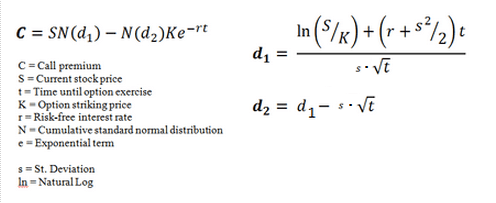
The above image shows the full original formula of how we can use the Black-Scholes Model to price options. It may look complicated but mainly the key input that we have to put in are the current stock price, the strike price, time to expire in days, the volatility or also known as the implied volatility in % terms as well as the current risk-free interest rate.
Fortunately for us, we can use an online Black Scholes Model calculator to calculate the options pricing for us. We only need to enter the fields required and the calculator is able to do the rest for us. The calculator can be found here at TradingToday.com. To test out the calculator, I did a calculation on a call option pricing on one of the stocks of my choice in the US options market. See the screenshot below.
New update as of 24 May 2022: TradingToday calculator seems to be offline the last I checked. I found another calculator by Good Calculators, which also has The Black Scholes Option Calculator.

Source: TradingToday
The calculator showed me a value of about $7.30 as you can see above for the call options. I then compared it with the real call options pricing value in the US options market which is lower at $6.38 – which might indicate that the current options market is pricing the options too cheaply. Or there is also a possibility that the parameters or assumptions the market is currently using are a little different than the one that I use. But more importantly, through this knowledge, we will be able to know how the options price will behave when certain conditions change such as the interest rate and the volatility – and profit from it. And my personal favourite is through selling the options to get premiums.
In the second part of the article, I am going to share with you guys the limitations of The Black-Scholes Model and how we can take advantage of it.
Disclaimer:
The information provided is for general information purposes only and is not intended to be a personalized investment or financial advice.
Important: Please read our full disclaimer.
Is SIA Shares Worth Buying? Here Are My Thoughts (August 2020)
Think About How SIA Was When Times Was “Normal” Before we got into this COVID-19 mess, SIA is already not a great business to own even when times were “normal.” All of us know that the airline […]
The Eight Accounting Fraud or Red Flag Signs To Look Out In Stocks
In this article, I’d like to share eight signs of potential fraud in our stocks portfolio that we should be careful of. These are eight simple potential warning signs of bad financial reporting or early markers […]
My 5 Key Takeaway From AEM Holdings 1H 2020 Results
3. As of 1H20, Most Earnings Paid Out As Dividends Based on AEM 1H20 reports, their cumulative capital allocation breakdown from 2017 to 1H2020 is as follows: Dividends – 47%, Acquisitions – 25%, Capex – 18%, Buybacks – 10%. It is interesting to note that […]
Kodak Stock is Up Over 1,400% in Two Days. Does It Make Sense?
Eastman Kodak Company (NYSE: KODK) opened at $2.15 (Monday) on July 27, 2020, and closed at $33.20 (Wednesday) by 29 July 2020. That is a 1,444.19% increase over a two day period. In this article, I am going to give you some background on the Kodak company, the reason […]
Here Are 4 Reasons Why Intel Stock Plunged 16% Last Friday
Last Friday on 24 July 2020, Intel closed 16.24% down. Although I do not own any Intel stock, I was curious why it fell after releasing its Q2 2020 results. Just a while ago, I saw the news that after 15 years of partnership, Apple decided to break up with Intel and stop using its […]
My 5 Key Takeaway From Temasek Portfolio Value in 2020
1. Temasek Portfolio is Huge. Although I know that Temasek has a huge portfolio, I was surprised to see that it is around the size of Warren Buffett’s. As of 31 March 2020, the net portfolio value or NPV is at S$306 billion. So we have our own Warren Buffett in Singapore, that is […]
What I Learnt From Adam Smith About Investment and Money
Who is Adam Smith? Adam Smith (1723-1790) was a philosopher and economist who was best known for authoring the book An Inquiry into the Nature and Causes of the Wealth of Nations. Wealth of Nations also happens to be one of Warren Buffett’s favourite books […]
A List of Value Investing Funds in Singapore and Outside of Singapore
As a value investor, as a practitioner of value investing, I am very interested in studying funds I view as an executioner of the various value investing methodologies I myself am very passionate about. In this article, I will list down some of the value investing funds in […]
Protected: My Gratitude Journal as An Investor (And The Benefits of It)
There is no excerpt because this is a protected post.
How to Get Rich by Investing in Stock Market? Patience
How do people get rich by investing in stocks? Can we actually get rich by investing in stocks? Yes, we can. But we need to utilize both Patience and Compound Interest in Great Companies. With the proper foundation, framework, character, and skills, I truly believe that […]
Here’s What Sun Tzu Art of War Quotes Can Teach Us About Investing
Sun Tzu Art of War Quotes “He will win who knows when to fight and when not to fight” – We should only invest when there is clear benefit to do so, do not do something just for the sake of doing something. “If you know the enemy and know yourself, you need not fear […]
Thinking, Fast and Slow Book Summary (What I Learnt As An Investor)
In this thinking fast and slow book summary, I will explain to you the various human biases that we have and why it is important for us as investors to understand it. It all begins with a simple premise that we all have two systems in our brain, system 1 and system 2 […]
Wait, Wait!
I often share insights that I do not share in this blog over at my Facebook page. Don’t forget to like it before you go!

High dividend yield, blue-chip stocks, is it safer? | Re-ThinkWealth.com
Many investors love to invest based on dividend yield alone. They think that dividend stocks are safe, but are all of […]
![The Best Investors And Money Managers of All Time [Ultimate List]](https://www.re-thinkwealth.com/wp-content/uploads/2021/05/warren-buffett-1024x675.jpg)
The Best Investors And Money Managers of All Time [Ultimate List]
The purpose of this article is to compile a list of some of the worlds greatest investors and money managers. We will also […]
How to Invest Like Chamath Palihapitiya
Who is Chamath Palihapitiya? Chamath is a former Facebook executive who became a venture investor. How to invest like Chamath […]

8 Practical Way For Stock Investors To Be Emotionally Intelligent
Scientists have discovered that emotions are generally caused by our own thoughts. That means that two people in the same situation […]

Here Are The Daily Routine That Has Helped Me As A Stock Investor
For stock investors, I am a firm believer in having an optimized routine that supports us emotionally and rationally – so we can hopefully […]

Here’s My Investment Outlook for 2021 (Is It A Year of Recovery?)
2020 has been another great year for my portfolio. My portfolio is up around 81.24% for the year compared to the S&P 500 total […]

Year in Review: The 20 Most Popular Re-ThinkWealth Articles of 2020
20. Does Warren Buffett Invest In Options? Yes, But It’s Not What You Think Most people will not associate The Oracle of Omaha […]
Does Warren Buffett Invest In Options? Yes, But It’s Not What You Think
Options, Weapon of Mass Destruction? Most people will not associate The Oracle of Omaha with options. Because after all, options are […]