
Investing
5 Things to Do During A Stock Market Crash | Re-ThinkWealth
Chris Lee Susanto, Founder at Re-ThinkWealth.com
24 November 2018

If you are an investor of stocks, you would know that currently (as of November 2018), we are in a (or nearing) stock market correction/bear territory. Before things get worse, here are 5 intelligent things to do during any stock market crash.
Here is what to do during any stock market crash:
—
1. Don’t Panic
Source: Yahoo Finance
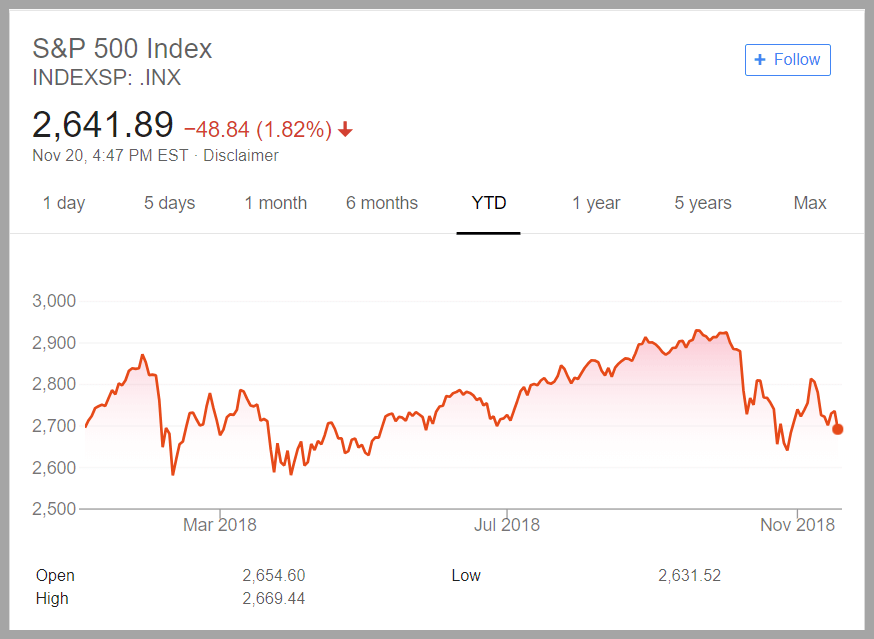
As you can see from the above image, as of 19 November 2018, the recent stock market correction has erased all of the 2018 gains for the S&P500. And a little more. The S&P 500 started the year at $2695.81. As of 19 November 2018, it closed at $2690.73.
The STI ETF is also not doing well either this year. Based on Yahoo FInance, the STI ETF went from as high as 3.66 on 24 January 2018 to 3.02 in 29 October 2018. That is a drop of about 17.5%. Near a bear market territory (defined as a 20% drop from previous high).
Recently, a Morgan Stanley analyst called Michael Wilson has also just sent a six-word reality check in a research note to its clients: “We are in a bear market.” The S&P 500 or the STI ETF may not have dropped by 20% from its previous all-time high. But some of our stocks holdings may have fallen more than 20%. Especially the technology or growth stocks.
How did your stock holdings do? I am sure that the past few weeks have not been a smooth ride up.
The first thing to do is not to panic. As Warren Buffett has said, a rattled mind will not make good decisions. And as a good value investor, we have to stay calm.
2. Be Realistic in Re-Assessing The Fundamentals of The Companies You Own
So you have bought some stocks. And due to the market crash, the price of your stock holdings fell. As a human being, it is normal if you subconsciously gravitate to defending your stock positions and say that you are right. Nobody likes to be wrong. But we have to be realistic. The father of value investing Benjamin Graham often said that value investor is a realist who buys stocks from the pessimist and sells to the optimist. We have to be a realist. We have to realistically assess the fundamentals of the companies that we are vested in during a market crash. Are we wrong? Are we right? Be a realist.
Based on a Harvard Business Review article, it said that Intellectual Humility is key. Being intellectually humble means that we should have the willingness to change, plus the wisdom to know when we shouldn’t. During a stock market crash, we need to have intellectual humility.
The fundamental of value investing is that behind every stock is a company. If the company do well, the stock will do well. If the company does badly, the stock will do badly. During a stock market crash, we need to re-assess the companies behind the stocks that we hold. Are they doing well or are they doing badly?
There are different parts of a company that we need to re-assess. First up, the company’s ability to be profitable and provide good amounts of free cash flow. If they pay dividends, take a close look at their payout ratio. We need to also see how well are they managing their debt. Management’s compensations and ability to manage well is an area we should analyze well too. Last but not least, their valuation. We need to be realistic in valuing the companies’ stocks that we are vested in. It is best that we have different possible scenarios simulated when we are doing our valuations. We have to also be conservative in our valuation assumptions. Remember not to forget to apply the concept of margin of safety.
When we re-assess the fundamentals of our company, be aware that we humans are emotional creatures. Be aware of the subconscious influences that we have as a human being. Some of the harmful subconscious influences include overconfidence and confirmation bias. Overconfidence is harmful because we might think we are unbeatable and we are always right. Being overconfident means that we are less likely to admit we are wrong. We have to be ready to admit we are wrong and cut our losses. Confirmation bias is especially harmful because subconsciously, we tend to look for only evidence that confirms our beliefs. Even though, our beliefs may be wrong. In confirmation bias, we are not being objective. We are not looking at evidence from both sides and take a look at it seriously. Be aware if we are being overconfident or displaying confirmation bias behavior.
The process of losing money is painful. We can feel regret on why we did not sell our stocks sooner. A lot of negative emotions may be flowing through our body. We may continuously look for news and evidence to comfort us that we are still alright. It is normal. But stop, be logical. Re-assess the fundamentals of the companies that you are holding objectively. Being a realist is key to be successful in value investing.
3. Decide What You Want to Do: Sell, Buy More or Do Nothing
“In life and business, there are two cardinal sins. The first is to act precipitously without thought and the second is to not act at all.” – Carl Icahn
After we have re-assessed the fundamentals of the company that we own, the next thing to do is to decide what do we want to do with our stock holdings:
- We can sell. Because we realized that we are wrong.
- We can buy more. Because we think that based on the latest facts, our thesis still holds and there are no other stocks in our radar that are more undervalued than this one.
- We can do nothing. If we are right and although these stocks are undervalued, they are not currently a strong buy.
- Also, we can do nothing if we simply have no cash left. And yet we think our thesis remains solid based on the latest facts.
- We can hold some and sell some to buy other stocks. If other stocks have a better price to value proposition. But we still want to have exposure in our current stock holdings.
In any case, decide what you want to do. Sell, buy more or do nothing.
4. Pen Down Your Thought Process That Leads to Your Decision
It is important that we pen down our thought process that leads to our decision in a particular moment in time.
Being a successful value investor is not easy. Having the right thinking and investment decision process is important. With the right thinking and decision process, naturally good results will follow. Different people have different thinking and decision process. This is because different people have a different character. It is important to know the cause-effect relationship between our character and our thought process and our decision. That is why penning down our thought process that leads to our investment decision is important.
5. After Some Time, Assess If You Made The Right Decision. Learn From It.
“The game of investing is a process of discovering who you are, what you’re interested in, what you’re good at, what you love to do, then magnifying that until you gain a sizable edge over all the other people.”- Li Lu
The game of investing is a continuous learning process. To be a good investor takes a long time. By writing down our thought process that leads to our decision, we are able to learn. After some time, we are able to know whether what we did was right or wrong. Most importantly, we can learn from it if we are wrong. And repeat it if we are right. In any case, we can only be a better investor if we keep on learning. Only those that keep on learning & reflecting will keep on rising on life.
In summary, during a stock market crash, these are the 5 steps you need to do: [1] Don’t panic, [2] Be realistic in re-assessing the fundamentals of the companies you own [3] Decide what you want to do: sell, buy more or do nothing [4] Pen down your thought process that leads to your decision [5] After some time, assess if you made the right decision and learn from it.
Disclaimer:
The information provided is for general information purposes only and is not intended to be a personalized investment or financial advice.
Important: Please read our full disclaimer.
More From Me:
My Week 5 Summary of Yale University Financial Markets Course: Derivatives, Futures, Forwards and Options Market
Introduction to Derivatives, Futures, Forwards, and Options market from Professor Robert Shiller The derivatives market is a market for securities with a price that is dependent upon or derived from one or more underlying assets. Examples of Derivates market are...
My Week 4 Summary of Yale University Financial Markets Course part 2: Regulations of Companies
Introduction to Regulation and Enterprise from Professor Robert Shiller Regulatory bodies US government set up Picture source: Google In 1968, the US government set up Federal National Mortgage Association (Fannie May) and in 1970, the US government set up Federal...
My Week 4 Summary of Yale University Financial Markets Course part 1: Real Estate
Introduction to Real Estate from Professor Robert Shiller Picture source: Google Real Estate is one of the most important classes of asset in the world and it is generally privately held in most countries. With the exception of China, whereby the government...
Keryx Biopharmaceuticals could be an Interesting Biotech Stock Play
Keryx Biopharmaceuticals Inc (NASDAQ: KERX) is essentially a bio-pharmaceutical company focused on the research, development and commercialization of pharmaceutical products geared towards patients with kidney disease and their healthcare providers. High volatility c...
Do You Know What Is Private Equity?
Differences Between Public Firm And Private Firm In Terms Of Buying Of Their Equity Stake "Equity" is another word that means the same as "stock"- which means that when you own it, you are owning a percentage of the company (the percentage of how much of the company...
4 Secrets For Thinking Positively
Humans are emotional creatures and most of the time, we cannot control our emotions when we feel sad or happy. However, we can train our mind to think good thoughts. When we control what we think, we can control what we feel. Think with the end in mind - Amidst the...
My Week 3 Summary of Yale University Financial Markets Course: Theory of Debt
In this module, Professor Shiller discusses the theory of debt and its proper role. He also covers corporate stocks. A naïve view of what stocks are is that it is some certificate that people buy so that the price can go up. That is not what stocks are. Stocks...
The Federal Reserve Raises Interest Rate: What Does It Mean For Us?
After almost a decade, The Federal Reserve raises a higher interest rate for the first time. The Federal Open Market Committee unanimously voted to set the new target range for the federal funds rate at 0.25 percent to 0.5 percent, up from zero to 0.25 percent. Policy...
Will The Fed Finally Raise Interest Rate on 16 Dec 2015?
The expectation was based on Chair Janet Yellen's oft-repeated stance that she'd like to see rate rises before the end of 2015. The last time the United States Federal Reserve raised their interest rates was back in 2006, a decade ago. With shares and commodity...
Here Is Everything You Need To Know About The Singapore Savings Bonds
What Are Bonds Bonds are one of the methods for corporations and governments to raise funds. It is a form of borrowing whereby we lend money to the government or corporations and we earn interest on it. We are able to redeem the principal amount but normally there is...
Seven Steps For Starting A Conversation
The seven steps for starting a conversation at a party Give a sincere smile and say Hello Provide a short introduction of who you are and give a firm handshake Listen closely to the person's name - Ask them to repeat it if you did not hear it clearly the first time...
My Week 2 Summary of Yale University Financial Markets Course: The History and Real Impact of Behavioral Finance
The History and The Real Impact of Behavioural Finance People are complex and our financial institutions are designed for real people. This study of behavioural finance started because of the revolution of neuroscience and the fact that the human brain is a...
Wait, Wait!
I often share insights that I do not share in this blog over at my Facebook page. Don’t forget to like it before you go!

Good Result and Yet The Stock Fell 10+% – GameStop’s So Unloved
The stock hit fresh near 13 year low despite the company doing pretty well during the earnings call on 28 March 2018. It closes at 10.39% down. It is not an easy day for any GameStop holders (except the short sellers), from my end, I am thinking where I could have gone wrong – or is the market wrong. I am more than willing to […]

Here’s My Thoughts on GameStop’s Q417 Earnings Results (Released 28/3/2018)
Despite the increase in sales and the beat in earnings from analyst estimates, their profits are still down 11.4% year on year basis on the adjusted diluted EPS portion (from $3.77 to $3.34). However, $3.34 is near the top of the management guidance for FY2017 – and the focus on improving the trade awareness where […]

5 Reasons Why Having The Long-Term View is Vital in Stock Investing
Having a long-term view is important in stock investing. And the reason is not just because many of the world’s most successful and richest investors such as Warren Buffett and Seth Klarman say so. “If you aren’t willing to own a stock for ten years, don’t even think about owning it for ten minutes” – Warren Buffett […]

Is GameStop Doomed? I Visited Their Stores in NY to Find Out
As of the market close on 11 January 2018 at $19.96, I am at a 7.81% paper gain excluding of realized gains I received via dividends and options premium. And GameStop consists of 30.80% of my portfolio – second on the list – with the first being Qualcomm at 40.60% of my portfolio. Naturally, going down to GameStop stores in New […]

Last day of 2017 – A Review of My Investment Journey So Far
This year, the stock market rally would have given many investors with a good profit – the Dow (top 30 company in the united states stock market) up 25%, S&P 500 (top 500 company in the united states stock market) up 19% and Nasdaq are up 28% this year. And I think it is maybe time to be cautious. Or I should say, cautiously […]
Here’s My Opinion on Bitcoin
Bitcoin is a currency that was founded/discovered pretty recently in 2009 by a person (still unknown) using the alias Satoshi Nakamoto.The good thing about transacting using Bitcoin is that there will be no middleman required to do the transacting. There is also no fees tagged to transacting with Bitcoin and no requirements […]

What is moat in Warren Buffett’s terms & why it’s important
Moat is important because it protects a company from losing their market share easily which will erode its earnings power over time. This is important for us as investors because we would want the company we invest in to have its earnings grow over time – then the share price will follow – and not the other way round. So, we […]

GameStop Q3 17 Earnings — Glad Going Against The Crowd Was Right
25% of their stores have already been turned to GameStop plus format which is a 50–50 combination of games and collectibles. What is interesting here is that despite lesser space to put video games, they actually see an increase in video games sales. This got to do with the new types of customers that these […]