
Investing
5 Things to Do During A Stock Market Crash | Re-ThinkWealth
Chris Lee Susanto, Founder at Re-ThinkWealth.com
24 November 2018

If you are an investor of stocks, you would know that currently (as of November 2018), we are in a (or nearing) stock market correction/bear territory. Before things get worse, here are 5 intelligent things to do during any stock market crash.
Here is what to do during any stock market crash:
—
1. Don’t Panic
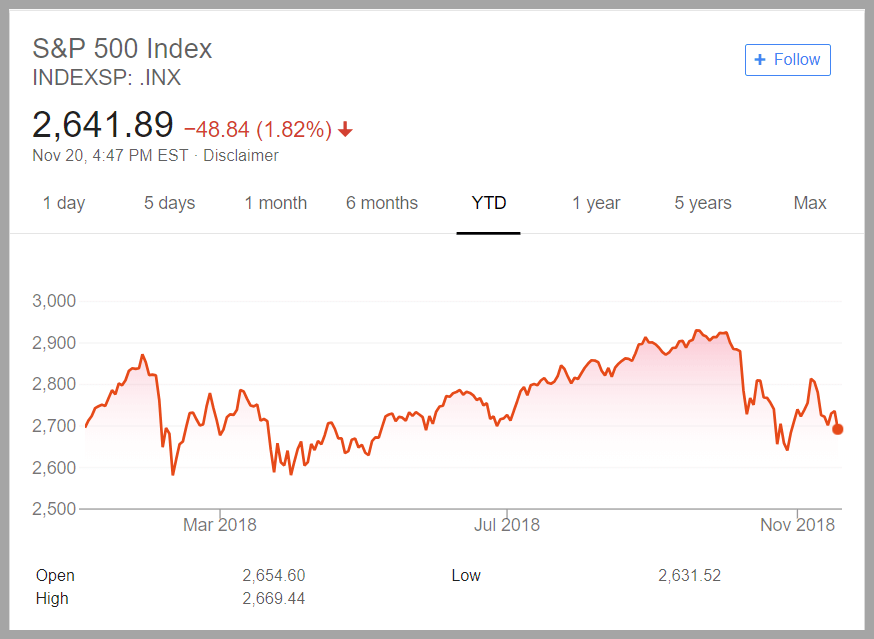
Source: Yahoo Finance
As you can see from the above image, as of 19 November 2018, the recent stock market correction has erased all of the 2018 gains for the S&P500. And a little more. The S&P 500 started the year at $2695.81. As of 19 November 2018, it closed at $2690.73.
The STI ETF is also not doing well either this year. Based on Yahoo FInance, the STI ETF went from as high as 3.66 on 24 January 2018 to 3.02 in 29 October 2018. That is a drop of about 17.5%. Near a bear market territory (defined as a 20% drop from previous high).
Recently, a Morgan Stanley analyst called Michael Wilson has also just sent a six-word reality check in a research note to its clients: “We are in a bear market.” The S&P 500 or the STI ETF may not have dropped by 20% from its previous all-time high. But some of our stocks holdings may have fallen more than 20%. Especially the technology or growth stocks.
How did your stock holdings do? I am sure that the past few weeks have not been a smooth ride up.
The first thing to do is not to panic. As Warren Buffett has said, a rattled mind will not make good decisions. And as a good value investor, we have to stay calm.
2. Be Realistic in Re-Assessing The Fundamentals of The Companies You Own
So you have bought some stocks. And due to the market crash, the price of your stock holdings fell. As a human being, it is normal if you subconsciously gravitate to defending your stock positions and say that you are right. Nobody likes to be wrong. But we have to be realistic. The father of value investing Benjamin Graham often said that value investor is a realist who buys stocks from the pessimist and sells to the optimist. We have to be a realist. We have to realistically assess the fundamentals of the companies that we are vested in during a market crash. Are we wrong? Are we right? Be a realist.
Based on a Harvard Business Review article, it said that Intellectual Humility is key. Being intellectually humble means that we should have the willingness to change, plus the wisdom to know when we shouldn’t. During a stock market crash, we need to have intellectual humility.
The fundamental of value investing is that behind every stock is a company. If the company do well, the stock will do well. If the company does badly, the stock will do badly. During a stock market crash, we need to re-assess the companies behind the stocks that we hold. Are they doing well or are they doing badly?
There are different parts of a company that we need to re-assess. First up, the company’s ability to be profitable and provide good amounts of free cash flow. If they pay dividends, take a close look at their payout ratio. We need to also see how well are they managing their debt. Management’s compensations and ability to manage well is an area we should analyze well too. Last but not least, their valuation. We need to be realistic in valuing the companies’ stocks that we are vested in. It is best that we have different possible scenarios simulated when we are doing our valuations. We have to also be conservative in our valuation assumptions. Remember not to forget to apply the concept of margin of safety.
When we re-assess the fundamentals of our company, be aware that we humans are emotional creatures. Be aware of the subconscious influences that we have as a human being. Some of the harmful subconscious influences include overconfidence and confirmation bias. Overconfidence is harmful because we might think we are unbeatable and we are always right. Being overconfident means that we are less likely to admit we are wrong. We have to be ready to admit we are wrong and cut our losses. Confirmation bias is especially harmful because subconsciously, we tend to look for only evidence that confirms our beliefs. Even though, our beliefs may be wrong. In confirmation bias, we are not being objective. We are not looking at evidence from both sides and take a look at it seriously. Be aware if we are being overconfident or displaying confirmation bias behavior.
The process of losing money is painful. We can feel regret on why we did not sell our stocks sooner. A lot of negative emotions may be flowing through our body. We may continuously look for news and evidence to comfort us that we are still alright. It is normal. But stop, be logical. Re-assess the fundamentals of the companies that you are holding objectively. Being a realist is key to be successful in value investing.
3. Decide What You Want to Do: Sell, Buy More or Do Nothing
“In life and business, there are two cardinal sins. The first is to act precipitously without thought and the second is to not act at all.” – Carl Icahn
After we have re-assessed the fundamentals of the company that we own, the next thing to do is to decide what do we want to do with our stock holdings:
- We can sell. Because we realized that we are wrong.
- We can buy more. Because we think that based on the latest facts, our thesis still holds and there are no other stocks in our radar that are more undervalued than this one.
- We can do nothing. If we are right and although these stocks are undervalued, they are not currently a strong buy.
- Also, we can do nothing if we simply have no cash left. And yet we think our thesis remains solid based on the latest facts.
- We can hold some and sell some to buy other stocks. If other stocks have a better price to value proposition. But we still want to have exposure in our current stock holdings.
In any case, decide what you want to do. Sell, buy more or do nothing.
4. Pen Down Your Thought Process That Leads to Your Decision
It is important that we pen down our thought process that leads to our decision in a particular moment in time.
Being a successful value investor is not easy. Having the right thinking and investment decision process is important. With the right thinking and decision process, naturally good results will follow. Different people have different thinking and decision process. This is because different people have a different character. It is important to know the cause-effect relationship between our character and our thought process and our decision. That is why penning down our thought process that leads to our investment decision is important.
5. After Some Time, Assess If You Made The Right Decision. Learn From It.
“The game of investing is a process of discovering who you are, what you’re interested in, what you’re good at, what you love to do, then magnifying that until you gain a sizable edge over all the other people.”- Li Lu
The game of investing is a continuous learning process. To be a good investor takes a long time. By writing down our thought process that leads to our decision, we are able to learn. After some time, we are able to know whether what we did was right or wrong. Most importantly, we can learn from it if we are wrong. And repeat it if we are right. In any case, we can only be a better investor if we keep on learning. Only those that keep on learning & reflecting will keep on rising on life.
In summary, during a stock market crash, these are the 5 steps you need to do: [1] Don’t panic, [2] Be realistic in re-assessing the fundamentals of the companies you own [3] Decide what you want to do: sell, buy more or do nothing [4] Pen down your thought process that leads to your decision [5] After some time, assess if you made the right decision and learn from it.
Disclaimer:
The information provided is for general information purposes only and is not intended to be a personalized investment or financial advice.
Important: Please read our full disclaimer.
More From Me:
Is Bitcoin Worth Investing in 2020? Here’s My Quick Thoughts
Bitcoin can be considered the world’s best-known cryptocurrency. Today is the 21st of November, 2020 and coincidentally, Bitcoin supply is also […]
Is Oculus Owned by Facebook? Yes And Here’s Why It’s Great
I have been wanting to buy the Oculus Quest for the longest time. A few years ago, when Oculus first came out with The Oculus Quest, I wanted to […]
Election Results: Biden or Trump? Here’s Why To The Stock Market, It Doesn’t Matter
Based on the current trend of the mail-in ballots, it seems likely that Biden is going to be the victor of the US election in
Why Netflix Raised The Price of It’s U.S. Subscription And Is It A Mistake?
Netflix currently has more than 65 million U.S. subscribers and about 195 million paid […] Their last hike for the U.S. price was in January 2019.
The Ultimate List of Investment and Finance Blogs/Websites in Singapore
Being an avid follower of many investment and finance blogs or websites in Singapore, I thought why not I create an
My 5 Key Takeaways From SPH FY2020’s Earnings
1. Long-Term Challenge With Media Division The first thing that comes to mind when we hear SPH is the newspaper. And newspaper makes money through […]
8 Value Investing Lessons From Beating The S&P 500 Return So Far
There are many value investing lessons that I have learned throughout these past five, six years. For today, I thought to share with you eight of the value investing lessons […]
Here Are My Five Key Takeaway From Tesla 2020 Battery Day
Elon Musk is a fantastic marketer and an innovative entrepreneur. I have been curious about the Tesla story for quite some time. And here are my five key takeaway from Tesla 2020 […]
Is Snowflake (NYSE: SNOW) Worth Investing? Here Are My 5 Takeaways
Snowflake does cloud computing that implements a variable pricing model, which can be at times more attractive than fixed packages […]
Nasdaq Is Officially In A Correction Territory: What Is Next?
The adage that “In the short run, the market is a voting machine but in the long run, it is a weighing machine.” by Benjamin Graham could not be more true over the past few days. As of 9 September 2020, […]
My 3 Thoughts on Yesterday’s Deepest US Market Decline Since June
Yesterday (3 September 2020), the US market had its deepest one day decline since June. The S&P 500 and Nasdaq had their deepest declines since June 11 and for Dow, it was their biggest decline since June 26 […]
Will The Stock Market Crash One More Time in 2020?
My Bet: In 2020, The Stock Market Will Not Crash Again. Yes, it is hard to predict where the stock market is heading in the short term. But my bet with regards to virus-related concern is that I do not think that we will crash again back to March-April Lows in 2020 just because of it […]
Wait, Wait!
I often share insights that I do not share in this blog over at my Facebook page. Don’t forget to like it before you go!

22.70% vs 15.19%; My Performance vs S&P 500 for Close to 7 Years
In this article, I am going to try to condense what I have reflected on, learned, and applied through […]

3Q 2021 Update to My Carnival Corp Stock Thesis
In June 2021, I wrote that I think Carnival Corp stock is likely going to sail higher in 2021. It took a […]

What is Sustainable Stock Investing and Does It Work?
What is Sustainable Stock Investing? ESG/ sustainable investing is a form of investing that is generally […]

Top 10 Warren Buffett Quotes on Investing | Re-ThinkWealth.com
Is FB a social media company? An advertising company? Or a chat company? Or a VR company? Online […]

Quick Analysis on FB Stock by Re-ThinkWealth.com (August 2021)
Is FB a social media company? An advertising company? Or a chat company? Or a VR company? Online […]

Growth or Value Investing? Why Not Both? – Re-ThinkWealth.com
Both value and growth investing have the same goal: which is to find the biggest opportunity or a gap or […]

Will Carnival Corp Stock Sail Higher in 2021? (June 2021)
“Carnival” based on the Oxford dictionary can also be defined as “a traveling funfair or circus.” The name is apt for a […]

Here Are My Quick Analysis on Palantir Technologies Stock (June 2021)
Palantir is a company that provides large organizations with a minimum of $500 million in revenue the ability to […]