
Investing
5 Things to Do During A Stock Market Crash | Re-ThinkWealth
Chris Lee Susanto, Founder at Re-ThinkWealth.com
24 November 2018

If you are an investor of stocks, you would know that currently (as of November 2018), we are in a (or nearing) stock market correction/bear territory. Before things get worse, here are 5 intelligent things to do during any stock market crash.
Here is what to do during any stock market crash:
—
1. Don’t Panic
Source: Yahoo Finance
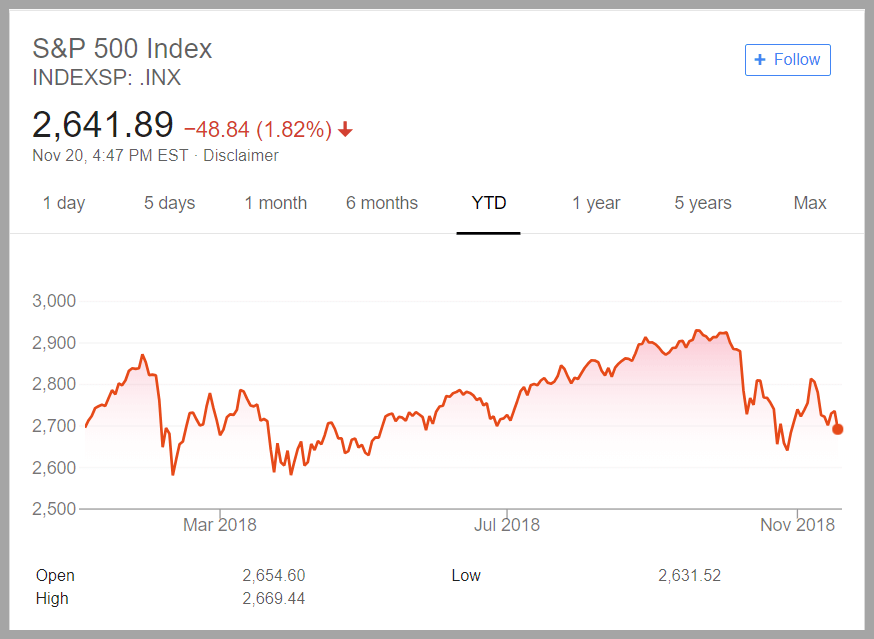
As you can see from the above image, as of 19 November 2018, the recent stock market correction has erased all of the 2018 gains for the S&P500. And a little more. The S&P 500 started the year at $2695.81. As of 19 November 2018, it closed at $2690.73.
The STI ETF is also not doing well either this year. Based on Yahoo FInance, the STI ETF went from as high as 3.66 on 24 January 2018 to 3.02 in 29 October 2018. That is a drop of about 17.5%. Near a bear market territory (defined as a 20% drop from previous high).
Recently, a Morgan Stanley analyst called Michael Wilson has also just sent a six-word reality check in a research note to its clients: “We are in a bear market.” The S&P 500 or the STI ETF may not have dropped by 20% from its previous all-time high. But some of our stocks holdings may have fallen more than 20%. Especially the technology or growth stocks.
How did your stock holdings do? I am sure that the past few weeks have not been a smooth ride up.
The first thing to do is not to panic. As Warren Buffett has said, a rattled mind will not make good decisions. And as a good value investor, we have to stay calm.
2. Be Realistic in Re-Assessing The Fundamentals of The Companies You Own
So you have bought some stocks. And due to the market crash, the price of your stock holdings fell. As a human being, it is normal if you subconsciously gravitate to defending your stock positions and say that you are right. Nobody likes to be wrong. But we have to be realistic. The father of value investing Benjamin Graham often said that value investor is a realist who buys stocks from the pessimist and sells to the optimist. We have to be a realist. We have to realistically assess the fundamentals of the companies that we are vested in during a market crash. Are we wrong? Are we right? Be a realist.
Based on a Harvard Business Review article, it said that Intellectual Humility is key. Being intellectually humble means that we should have the willingness to change, plus the wisdom to know when we shouldn’t. During a stock market crash, we need to have intellectual humility.
The fundamental of value investing is that behind every stock is a company. If the company do well, the stock will do well. If the company does badly, the stock will do badly. During a stock market crash, we need to re-assess the companies behind the stocks that we hold. Are they doing well or are they doing badly?
There are different parts of a company that we need to re-assess. First up, the company’s ability to be profitable and provide good amounts of free cash flow. If they pay dividends, take a close look at their payout ratio. We need to also see how well are they managing their debt. Management’s compensations and ability to manage well is an area we should analyze well too. Last but not least, their valuation. We need to be realistic in valuing the companies’ stocks that we are vested in. It is best that we have different possible scenarios simulated when we are doing our valuations. We have to also be conservative in our valuation assumptions. Remember not to forget to apply the concept of margin of safety.
When we re-assess the fundamentals of our company, be aware that we humans are emotional creatures. Be aware of the subconscious influences that we have as a human being. Some of the harmful subconscious influences include overconfidence and confirmation bias. Overconfidence is harmful because we might think we are unbeatable and we are always right. Being overconfident means that we are less likely to admit we are wrong. We have to be ready to admit we are wrong and cut our losses. Confirmation bias is especially harmful because subconsciously, we tend to look for only evidence that confirms our beliefs. Even though, our beliefs may be wrong. In confirmation bias, we are not being objective. We are not looking at evidence from both sides and take a look at it seriously. Be aware if we are being overconfident or displaying confirmation bias behavior.
The process of losing money is painful. We can feel regret on why we did not sell our stocks sooner. A lot of negative emotions may be flowing through our body. We may continuously look for news and evidence to comfort us that we are still alright. It is normal. But stop, be logical. Re-assess the fundamentals of the companies that you are holding objectively. Being a realist is key to be successful in value investing.
3. Decide What You Want to Do: Sell, Buy More or Do Nothing
“In life and business, there are two cardinal sins. The first is to act precipitously without thought and the second is to not act at all.” – Carl Icahn
After we have re-assessed the fundamentals of the company that we own, the next thing to do is to decide what do we want to do with our stock holdings:
- We can sell. Because we realized that we are wrong.
- We can buy more. Because we think that based on the latest facts, our thesis still holds and there are no other stocks in our radar that are more undervalued than this one.
- We can do nothing. If we are right and although these stocks are undervalued, they are not currently a strong buy.
- Also, we can do nothing if we simply have no cash left. And yet we think our thesis remains solid based on the latest facts.
- We can hold some and sell some to buy other stocks. If other stocks have a better price to value proposition. But we still want to have exposure in our current stock holdings.
In any case, decide what you want to do. Sell, buy more or do nothing.
4. Pen Down Your Thought Process That Leads to Your Decision
It is important that we pen down our thought process that leads to our decision in a particular moment in time.
Being a successful value investor is not easy. Having the right thinking and investment decision process is important. With the right thinking and decision process, naturally good results will follow. Different people have different thinking and decision process. This is because different people have a different character. It is important to know the cause-effect relationship between our character and our thought process and our decision. That is why penning down our thought process that leads to our investment decision is important.
5. After Some Time, Assess If You Made The Right Decision. Learn From It.
“The game of investing is a process of discovering who you are, what you’re interested in, what you’re good at, what you love to do, then magnifying that until you gain a sizable edge over all the other people.”- Li Lu
The game of investing is a continuous learning process. To be a good investor takes a long time. By writing down our thought process that leads to our decision, we are able to learn. After some time, we are able to know whether what we did was right or wrong. Most importantly, we can learn from it if we are wrong. And repeat it if we are right. In any case, we can only be a better investor if we keep on learning. Only those that keep on learning & reflecting will keep on rising on life.
In summary, during a stock market crash, these are the 5 steps you need to do: [1] Don’t panic, [2] Be realistic in re-assessing the fundamentals of the companies you own [3] Decide what you want to do: sell, buy more or do nothing [4] Pen down your thought process that leads to your decision [5] After some time, assess if you made the right decision and learn from it.
Disclaimer:
The information provided is for general information purposes only and is not intended to be a personalized investment or financial advice.
Important: Please read our full disclaimer.
More From Me:
Is SIA Shares Worth Buying? Here Are My Thoughts (August 2020)
Think About How SIA Was When Times Was “Normal” Before we got into this COVID-19 mess, SIA is already not a great business to own even when times were “normal.” All of us know that the airline […]
The Eight Accounting Fraud or Red Flag Signs To Look Out In Stocks
In this article, I’d like to share eight signs of potential fraud in our stocks portfolio that we should be careful of. These are eight simple potential warning signs of bad financial reporting or early markers […]
My 5 Key Takeaway From AEM Holdings 1H 2020 Results
3. As of 1H20, Most Earnings Paid Out As Dividends Based on AEM 1H20 reports, their cumulative capital allocation breakdown from 2017 to 1H2020 is as follows: Dividends – 47%, Acquisitions – 25%, Capex – 18%, Buybacks – 10%. It is interesting to note that […]
Kodak Stock is Up Over 1,400% in Two Days. Does It Make Sense?
Eastman Kodak Company (NYSE: KODK) opened at $2.15 (Monday) on July 27, 2020, and closed at $33.20 (Wednesday) by 29 July 2020. That is a 1,444.19% increase over a two day period. In this article, I am going to give you some background on the Kodak company, the reason […]
Here Are 4 Reasons Why Intel Stock Plunged 16% Last Friday
Last Friday on 24 July 2020, Intel closed 16.24% down. Although I do not own any Intel stock, I was curious why it fell after releasing its Q2 2020 results. Just a while ago, I saw the news that after 15 years of partnership, Apple decided to break up with Intel and stop using its […]
My 5 Key Takeaway From Temasek Portfolio Value in 2020
1. Temasek Portfolio is Huge. Although I know that Temasek has a huge portfolio, I was surprised to see that it is around the size of Warren Buffett’s. As of 31 March 2020, the net portfolio value or NPV is at S$306 billion. So we have our own Warren Buffett in Singapore, that is […]
What I Learnt From Adam Smith About Investment and Money
Who is Adam Smith? Adam Smith (1723-1790) was a philosopher and economist who was best known for authoring the book An Inquiry into the Nature and Causes of the Wealth of Nations. Wealth of Nations also happens to be one of Warren Buffett’s favourite books […]
A List of Value Investing Funds in Singapore and Outside of Singapore
As a value investor, as a practitioner of value investing, I am very interested in studying funds I view as an executioner of the various value investing methodologies I myself am very passionate about. In this article, I will list down some of the value investing funds in […]
Protected: My Gratitude Journal as An Investor (And The Benefits of It)
There is no excerpt because this is a protected post.
How to Get Rich by Investing in Stock Market? Patience
How do people get rich by investing in stocks? Can we actually get rich by investing in stocks? Yes, we can. But we need to utilize both Patience and Compound Interest in Great Companies. With the proper foundation, framework, character, and skills, I truly believe that […]
Here’s What Sun Tzu Art of War Quotes Can Teach Us About Investing
Sun Tzu Art of War Quotes “He will win who knows when to fight and when not to fight” – We should only invest when there is clear benefit to do so, do not do something just for the sake of doing something. “If you know the enemy and know yourself, you need not fear […]
Thinking, Fast and Slow Book Summary (What I Learnt As An Investor)
In this thinking fast and slow book summary, I will explain to you the various human biases that we have and why it is important for us as investors to understand it. It all begins with a simple premise that we all have two systems in our brain, system 1 and system 2 […]
Wait, Wait!
I often share insights that I do not share in this blog over at my Facebook page. Don’t forget to like it before you go!

High dividend yield, blue-chip stocks, is it safer? | Re-ThinkWealth.com
Many investors love to invest based on dividend yield alone. They think that dividend stocks are safe, but are all of […]
![The Best Investors And Money Managers of All Time [Ultimate List]](https://www.re-thinkwealth.com/wp-content/uploads/2021/05/warren-buffett-1024x675.jpg)
The Best Investors And Money Managers of All Time [Ultimate List]
The purpose of this article is to compile a list of some of the worlds greatest investors and money managers. We will also […]

How to Invest Like Chamath Palihapitiya
Who is Chamath Palihapitiya? Chamath is a former Facebook executive who became a venture investor. How to invest like Chamath […]

8 Practical Way For Stock Investors To Be Emotionally Intelligent
Scientists have discovered that emotions are generally caused by our own thoughts. That means that two people in the same situation […]

Here Are The Daily Routine That Has Helped Me As A Stock Investor
For stock investors, I am a firm believer in having an optimized routine that supports us emotionally and rationally – so we can hopefully […]

Here’s My Investment Outlook for 2021 (Is It A Year of Recovery?)
2020 has been another great year for my portfolio. My portfolio is up around 81.24% for the year compared to the S&P 500 total […]

Year in Review: The 20 Most Popular Re-ThinkWealth Articles of 2020
20. Does Warren Buffett Invest In Options? Yes, But It’s Not What You Think Most people will not associate The Oracle of Omaha […]
Does Warren Buffett Invest In Options? Yes, But It’s Not What You Think
Options, Weapon of Mass Destruction? Most people will not associate The Oracle of Omaha with options. Because after all, options are […]