Stock analysis/investing
High dividend yield, blue-chip stocks, is it safer? | Re-ThinkWealth.com
3 June 2021
Many investors love to invest based on high dividend yield alone. Are you one of them?
Some people think that dividend stocks are safer, but is it true?
In this article, I will be sharing some of the misconceptions we need to be wary of when investing in dividend stocks.
I will be answering some of the misconceptions like: are investing in “blue-chips”/dividend stocks safer or is investing in high dividend yield stocks good?
Are Dividend Stocks and So-called “Blue-Chips” Safer?
First, let me get it out of the way: stocks are not inherently safer or riskier because they are dividend stocks or “blue-chips”.
I personally view risk as a permanent loss of capital. What is your view of risks?
A dividend stock or “blue-chip” can be risky if the business is in a perpetual decline or if the management is destroying the value of the company through bad management (and as a result, the company has to cut dividends). And not only that, if the business does not perform well in the future, capital losses on top of dividend cuts are bound to come as well.
Essentially, dividend stocks or “blue-chips” can be very risky if we do not understand them well and as a result, we might be buying into a company whose future is going to become worst over time and their share price will reflect that. This is the definition of “value trap” – buying into a company whose shares have fallen and the share price falls further because the business did not improve for the foreseeable future.
Does High Dividend Yield Means It’s A Good Sign?
High dividend yield companies can be a potential sign of a “value trap”.
Remember, the dividend yield is calculated by taking the company’s latest dividends dividing it by the company’s current share price. Sometimes, a company’s share price may fall a lot and as a result, the dividend yield goes up.
But remember, the dividend yield is a lagging indicator. If the company’s business performance continues to do worse into the future, the company’s share price may fall further and the dividend may even be cut or eliminated entirely. A company is usually cheap for a reason.
Buying a company’s stock just because they have a high dividend yield without understanding the business and the future of the business can be a recipe for disaster.
So, What To Look Out For When Investing in Dividend Stocks?
Many investors like dividend-paying companies because of their ability to generate income on top of potential capital gains. But one thing to note is that both dividends and retained earnings technically should come from the same place, which is net income. Without sufficient net income, a company will need to cut or eliminate dividends, or else, it will not be sustainable.
Hence, when looking at dividend-paying companies, I believe that ultimately the key thing to note and look out for is whether the company’s business can sustain and grow over the long run or not. Because remember, sustainable dividends come from the business’s ability to generate sustainable returns on its equity over the long run.
To estimate how much more the company dividend can grow, it can be useful to use the sustainable growth rate formula to estimate it. Take the company’s ROE and multiplying it by the company’s retention rate (1 – dividend payout ratio). For example, if a company has an ROE of 15% and a dividend payout ratio of 0.5, that means that the company still has 15% x (1 – 0.5) = 7.5% more room to grow its dividends based on the sustainable growth rate formula.
When analyzing dividend stocks, look at it from the point of view of us becoming a business owner in that business. What do we want to see? We want to see whether the company has good management that has executed well in the past. We want to see their performance so far in terms of revenue growth, earnings, ROE, etc. We want to see if they are in any danger with regard to their leverage. We also want to see if the future of the company looks brighter than it is today or it is not. Among others.
In summary, when looking at dividend stocks, do not have the illusion that because they have a high dividend yield or it is a “blue-chip” company, it is safe.
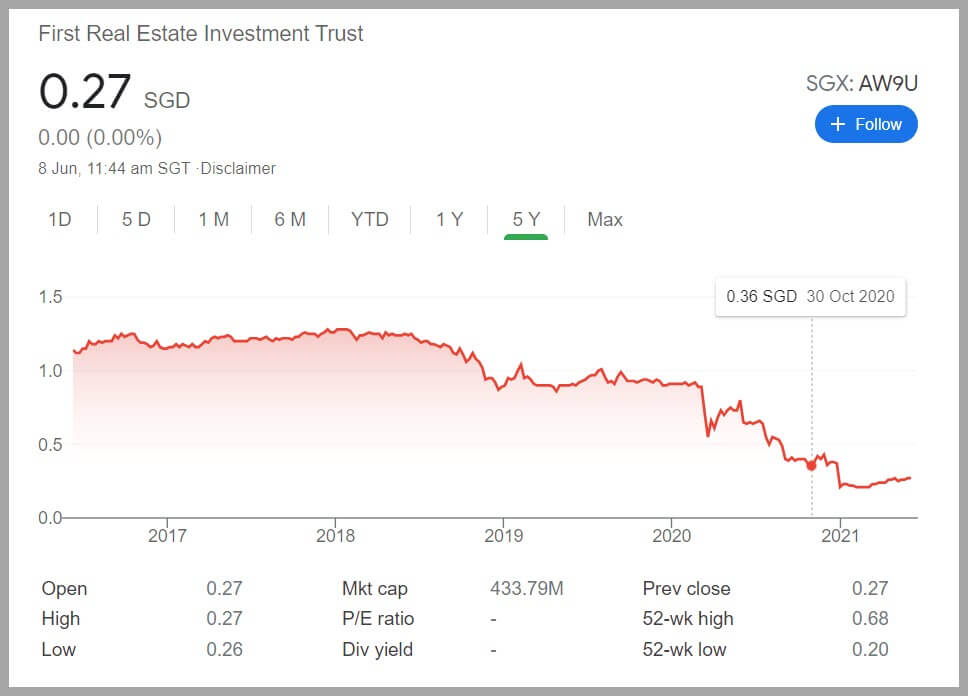
Image source: Google
Safety comes from the business and managerial strength and us knowing what we invest in. Not simply whether they have a high dividend yield or it is a “blue-chip” company. Especially not simply because they have a high dividend yield. Just look at First Reit stock above, when it fell to around 90 cents, the dividend yield was getting higher – but as of now, it can be seen that they are all just an illusion because the business continues to perform poorly (a classic definition in my view, of a value trap at 90 cents).
Disclaimer:
The information provided is for educational and general information purposes only and is not intended to be personalized investment or financial advice. We make no promises as to the accuracy or usefulness of the information we present.
Important: Please read our full disclaimer.
Learned something?
Share this article with your friends in your WhatsApp or Telegram group now!

Chris Lee Susanto
Founder, investment blogger, and editor of this value investing x business-like stock investing blog Re-ThinkWealth.com.
Chris is a big proponent of business-like stock investing. He invests in companies where there is value to be found, be it a turnaround, depressed, value, or quality growth company (compounders). He either buys the stock outright or he profits through selling put or selling call options – or buying call options (buying and selling options are especially dangerous for those who do not know how to properly execute it).
Some of the places where Chris has been invited to speak or have added value as a mentor or writer includes Singapore Polytechnic, SMU Institute of Innovation and Entrepreneurship (IIE), Dollars and Sense, The New Savvy, Value Walk Blog, Investment Moats, NUS Tembusu College, NUS Investment Society, CGS-CIMB Singapore, Singapore Financial Conference by NTU IIC, The Financial Coconut Podcast, Money FM 89.3 and Internationally in Myanmar.
Being a full-time investor, Chris knows that he did not beat the S&P 500 return so far (as of the time of this writing) by listening to stock tips. So, when he teaches, he also doesn’t believe in giving stock tips as it is not sustainable for you in the long run.
As of now, Chris’s focus is on setting up a MAS Licensed Fund in the future with the goal to beat the market over the long run. Feel free to join his free investment telegram channel here to be the first to be updated on his new articles.
Don’t Leave First, Read Also:
The Eight Accounting Fraud or Red Flag Signs To Look Out In Stocks
In this article, I’d like to share eight signs of potential fraud in our stocks portfolio that we should be careful of. These are eight simple potential warning signs of bad financial reporting or early markers […]

My 5 Key Takeaway From AEM Holdings 1H 2020 Results
3. As of 1H20, Most Earnings Paid Out As Dividends Based on AEM 1H20 reports, their cumulative capital allocation breakdown from 2017 to 1H2020 is as follows: Dividends – 47%, Acquisitions – 25%, Capex – 18%, Buybacks – 10%. It is interesting to note that […]

Kodak Stock is Up Over 1,400% in Two Days. Does It Make Sense?
Eastman Kodak Company (NYSE: KODK) opened at $2.15 (Monday) on July 27, 2020, and closed at $33.20 (Wednesday) by 29 July 2020. That is a 1,444.19% increase over a two day period. In this article, I am going to give you some background on the Kodak company, the reason […]
Here Are 4 Reasons Why Intel Stock Plunged 16% Last Friday
Last Friday on 24 July 2020, Intel closed 16.24% down. Although I do not own any Intel stock, I was curious why it fell after releasing its Q2 2020 results. Just a while ago, I saw the news that after 15 years of partnership, Apple decided to break up with Intel and stop using its […]

My 5 Key Takeaway From Temasek Portfolio Value in 2020
1. Temasek Portfolio is Huge. Although I know that Temasek has a huge portfolio, I was surprised to see that it is around the size of Warren Buffett’s. As of 31 March 2020, the net portfolio value or NPV is at S$306 billion. So we have our own Warren Buffett in Singapore, that is […]
What I Learnt From Adam Smith About Investment and Money
Who is Adam Smith? Adam Smith (1723-1790) was a philosopher and economist who was best known for authoring the book An Inquiry into the Nature and Causes of the Wealth of Nations. Wealth of Nations also happens to be one of Warren Buffett’s favourite books […]

A List of Value Investing Funds in Singapore and Outside of Singapore
As a value investor, as a practitioner of value investing, I am very interested in studying funds I view as an executioner of the various value investing methodologies I myself am very passionate about. In this article, I will list down some of the value investing funds in […]

Protected: My Gratitude Journal as An Investor (And The Benefits of It)
There is no excerpt because this is a protected post.
How to Get Rich by Investing in Stock Market? Patience
How do people get rich by investing in stocks? Can we actually get rich by investing in stocks? Yes, we can. But we need to utilize both Patience and Compound Interest in Great Companies. With the proper foundation, framework, character, and skills, I truly believe that […]

Here’s What Sun Tzu Art of War Quotes Can Teach Us About Investing
Sun Tzu Art of War Quotes “He will win who knows when to fight and when not to fight” – We should only invest when there is clear benefit to do so, do not do something just for the sake of doing something. “If you know the enemy and know yourself, you need not fear […]
Thinking, Fast and Slow Book Summary (What I Learnt As An Investor)
In this thinking fast and slow book summary, I will explain to you the various human biases that we have and why it is important for us as investors to understand it. It all begins with a simple premise that we all have two systems in our brain, system 1 and system 2 […]
7 Key Investing Lessons from Charlie Munger & Li Lu Interview
I chanced upon an edited transcripts from Guru Focus of an interview of Munger and Li Lu in one of China’s top finance magazines. Here are the 7 investing lessons I learned from Charlie Munger and Li Lu’s interview: 1. In investing, patience is very […]