Reflections
Life, Relationship, Health, Business & Value Investing – My Thoughts at 26
Chris Lee Susanto, Founder at Re-ThinkWealth.com
16 April 2019

I have made a lot of mistakes in my life. I have been conned, cheated and have lost money in business deals and investments.
Today is my birthday so I thought it would be good to summarize the important lessons I have learned so far about life, relationship, health, business & value investing so far and share it with my readers.
I hope that you can take away some things and apply them to your life.
1. About Life
Life is meant to be treasured. Often times, we take life for granted. It is important to slow down, breathe, look around us and be grateful for everything that we have.
It is when we slow down and become present, then we can learn to really treasure life more often. Because time truly does fly. Meditation is one of the rituals I do to help me become more present.
Setting goals and priorities. Life is more fun when we have goals to chase after.
Before setting goals, we must listen to our environment and dig deep in order to know what we want. Setting goals to me are the aiming process of life (based on The Golden Key to Strategy book).
Running after our goals are the moving process and it is important that we are disciplined about how we move towards our goals.
When we want to claim our reward by achieving our goals, without a doubt we will encounter setbacks or failures.
We will encounter pains.
Ray Dalio shared that he has a pain button which means that when he encounters pains, setbacks, he will reflect on them to get to the root causes and diagnose for a solution. Because he says pain + reflection equals progress.
Setbacks are without a doubt an essential and valuable part of life, it teaches us so we can become a better person.
And that is how over time, we can set bigger goals.
I think these two books sum up a key part of my life strategy well today:
The Golden Key to Strategy book on the importance of the four-part process of listening, aiming, moving and claiming.
Ray Dalio Principles book especially on:
1. Pain + Reflection = Progress
2. Life is about setting goals, running hard after them, encountering setbacks, diagnose mistakes and create a solution and run after bigger goals!
3. Always question if things are true or not. Do not just accept things for what it is.
4. Because ultimately, the quality of our decisions will result in the quality of our life.
And lastly, about life, take it easy. Remember that while we should work hard to achieve our goals, we should learn to stop and smell the flowers. Take it easy. 🙂
2. About Relationship

I am the kind of person who values meaningful relationships for life. In fact, this is a company slogan by one of my first boss who is in the financial advisory line.
Having meaningful relationships requires us to know that nobody is perfect. We have to treasure and love them unconditionally. It is harder to do than it is to say.
The first step is: treasure those relationships.
And the second step is: make time for them, put in the effort to show we care.
Know that in a relationship, it will not all be rosy.
There will be ups and downs. Being there through all the ups and downs and show them that you treasure them is key.
In terms of life partner, finding the right one will be one of the biggest determinants of our future happiness and success.
In a relationship, don’t be calculative. Having all the money in the world means nothing if you do not have someone special to spend it with. Having open communication is key.
3. About Health

So far it’s:
Eat less.
Eat more banana (yep, I love banana).
Exercise often (make sure you sweat).
Sleep early (try to be disciplined about it).
Drink more water.
Don’t worry too much:
”People become attached to their burdens sometimes more than the burdens are attached to them.”
– George Bernard Shaw
“Our fatigue is often caused not by work, but by worry, frustration, and resentment.”
– Dale Carnegie
And finally, on worrying: we should stop worrying about what can go wrong, and get excited about what can go right.
Smile more often and listen to Charlie Munger on the secret to a long and happy life:
“You don’t have a lot of envy.
“You don’t have a lot of resentment.
“You don’t overspend your income.
“You stay cheerful in spite of your troubles.
“You deal with reliable people.
“And you do what you’re supposed to do.
“And all these simple rules work so well to make your life better. And they’re so trite.”
His prescription is logical, he says.
“Staying cheerful” is “a wise thing to do,” Munger told Quick, adding that in order to do so, you have to let go of negative feelings.
“And can you be cheerful when you’re absolutely mired in deep hatred and resentment? Of course you can’t. So why would you take it on?” Munger said.
4. About Business

Running a business can be harder than stock investing.
I have had the privilege to be both an investor and a business person.
So far what I have learned is in business, getting the right people and having the right process is key.
In business, we have to deal with people.
In stock investing, we do not deal with people unless we are an activist (which I am not).
Dealing with people is one of the hardest parts of the business. Because humans have emotions. Not only we must get the right people on board, but we must also train them while being patiently aware of their background and culture (I deal with business both in Indonesia and Singapore).
I can safely say that it is only through experience that we can be better at managing projects, dealing with people to come out to the best solutions for our clients.
My advice to my friends who are looking to start a business? is to follow Nike’s advice to Just Do It.
Having an academic credential is not key for starting a business (I have a polytechnic diploma in business and dropped out of SMU).
I do not think that lacking a degree made me less good in business. In fact, it motivates me much more because I do not have a degree to fall back on.
So if I can start something, I do not see why you can’t.
Two principles I think holds true in business:
“Do the work. Out-work. Out-think. Out-sell your expectations. There are no shortcuts.” – Mark Cuban
“People want to do business with someone they like. If people like you, the’re going to want to do business with you.” – Barbara Corcoran
5. About Value Investing
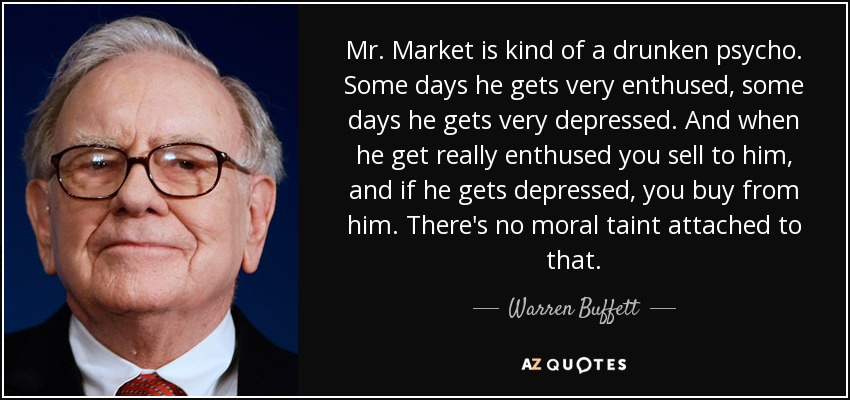
Source: AZ Quotes
Value investing can be summed up as the process of buying a business below its intrinsic value.
There are three key determinants for our success in the stock market:
1. The quality of the business (how long will the competitive advantage/moats last, is it durable enough)
– The better the competitive advantage is, the longer the stock can compound our money.
– If the competitive advantage of a company is not that good or we call it a narrow moat, it can be a case of buying a so-so business at an extremely cheap price. In this case, the key is the timing of entry and exit.
– In analyzing the moat of a company, the most dangerous disruption or erosion of a company’s moat can be new technological innovations.
2. The price it’s trading at relative to its intrinsic value (margin of safety when buying)
– Nowadays when buying a new company, I will remind myself to look for a larger margin of safety. This helps to account for possible mistakes in our valuation and analysis.
3. And lastly, managing our emotions (take advantage of greed and fear in the market and be aware of our psychological bias such as loss aversion and price anchoring)
– In investing, it is not only important to know when to buy a stock, but it is also equally crucial to know when to sell (and when not to sell).
– Understanding and being aware of the emotions inside of us will help to make rational buying and selling decisions.
Stock investing is very dynamic and it’s super fun (and super important). It is something that we can do no matter how old we are. When we are young, middle-aged and retired are all phases where we can utilize value investing to generate passive income for ourselves and our family.
6. Moving Forward

I will be looking to say no more often (especially to activities and people that is hard for me to say no to) so that I can have more time to say yes to the high-quality interactions and activities more related to my goal.
I am also in the midst of starting my CFA paper soon and hopefully pass all 3 levels of CFA in two years time. I am looking to be the rare few CFA charterholder without a degree (I have not met anyone who has a CFA with no Bachelor degree before, let me know if you have). Now, even though I believe that we do not need a CFA to be a great investor, I still like the challenge and extra learning and would love to conquer it.
I will also set Monday as a thinking day, an idea I modeled after from Brian Scudamore, a CEO of a $250 million+ company from a question he answers on Quora and got reposted on Inc.
Brian schedules his Monday just to think and here are an excerpt of what he says:
“Give me six hours to chop down a tree, and I will spend the first four sharpening the ax.” — Abraham Lincoln
Most people see leadership as a sport where success is determined by hard work. Instead, I like to think of business as being more like surgery.
My father was one of the top surgeons in Canada, so when I was young, I saw how doctors aim to have maximum impact with minimum intervention. Like Lincoln chopping down a tree, accomplishing this is about careful planning. The actual surgery — the physical work — is only a small part of the process.
I approach business the same way. The Mondays I devote to thinking allow me to operate with surgical precision during the rest of the week.
This is how I spend my 10 hours thinking:
Step #1: Schedule the whole day in your calendar
Are other people constantly taking your time and dictating your priorities? If so, the first step to finding time to devote to thinking is to take control of your calendar. Let people know that you won’t respond to emails or phone calls on a particular day unless there’s an emergency.
Step #2: Do NOT go to your office
My best ideas come when I’m not in the office, so I often spend the day wandering around Vancouver. I pick where to go based on the type of thinking that I need to do. On a given Monday, I might go through six coffee shops. I might walk in the forest, take a bike ride, hang out on the beach, sit on a park bench, or even have a glass of wine. Whenever I feel stuck, I move locations.
Step #3: Bring your journal
Writing is a powerful way to capture your ideas and get them into an organized, actionable form. The key is not to censor or judge yourself — just spill your thoughts onto paper without criticism or even evaluation. There are many ways to do this. I’m a very visual person, so my notebook is filled with pictures, arrows and words. Find what works best for you.
Step #4: Reschedule or shorten meetings you have later in the week
As I’m out of the office all Monday, my Tuesday, Wednesday, and Thursday are usually spent in back-to-back meetings. I set aside 15 minutes on Monday to review the meetings that are set up for the week and compare them to my priorities. If a meeting isn’t a high priority, I will ask my assistant to either reschedule it or shorten it.
Step #5: Prune your to-do list for the week
Most of those meetings lead to action steps. Over the course of the week, tasks pile up and my to-do list can become so long that it’s unrealistic for me to complete all of it. Rather than blindly checking off items as they come up, I use my thinking day to review the list and evaluate which ones are truly a priority. I ask myself: ‘Should we really action this?’ Often, I find that what seemed important at first isn’t anymore.
Step #6: Identify your top three outcomes for the day
Besides planning your week to come and reviewing your to-do list, set three goals for your thinking day and jot them down. This will ensure you get the maximum impact from those open hours.
Step #7: Use powerful questions to encourage deep thinking
You will also want to devote some of your time to thinking deeply about your priorities and the direction of your business. I find prompts are helpful for this. Here are some of my favorites:
Am I doing the right things with the right people?
What’s most important? What am I good at?
What am I bad at?
How can I spend more time doing what I’m good at?
How can I spend less time doing what I’m bad at?
Alternatively, I’ll write out a goal and think about how I can strategically move toward it.
Step #8: Set aside time to solve your biggest problems
As important as big-picture thinking is, every business will need to solve shorter-term problems. A portion of your day can also be spent investigating challenging issues and brainstorming ways to push through them.
Step #9: Set aside time to think of new ideas
Reacting to problems is essential, but so is proactively coming up with new ideas to better your business. Set aside some time to brainstorm new ways of doing things, or new opportunities to explore.
7. In Summary
In summary, the above are some of the important lessons that I have learned so far with regards to life, relationships, health, business, and value investing. I hope that by sharing it with you, you will be able to take away some of the points to implement it in your life too.
Disclaimer:
The information provided is for general information purposes only and is not intended to be a personalized investment or financial advice.
Important: Please read our full disclaimer.
Read also now:
Is Bitcoin Worth Investing in 2020? Here’s My Quick Thoughts
Bitcoin can be considered the world’s best-known cryptocurrency. Today is the 21st of November, 2020 and coincidentally, Bitcoin supply is also […]
Is Oculus Owned by Facebook? Yes And Here’s Why It’s Great
I have been wanting to buy the Oculus Quest for the longest time. A few years ago, when Oculus first came out with The Oculus Quest, I wanted to […]
Election Results: Biden or Trump? Here’s Why To The Stock Market, It Doesn’t Matter
Based on the current trend of the mail-in ballots, it seems likely that Biden is going to be the victor of the US election in
Why Netflix Raised The Price of It’s U.S. Subscription And Is It A Mistake?
Netflix currently has more than 65 million U.S. subscribers and about 195 million paid […] Their last hike for the U.S. price was in January 2019.
The Ultimate List of Investment and Finance Blogs/Websites in Singapore
Being an avid follower of many investment and finance blogs or websites in Singapore, I thought why not I create an
My 5 Key Takeaways From SPH FY2020’s Earnings
1. Long-Term Challenge With Media Division The first thing that comes to mind when we hear SPH is the newspaper. And newspaper makes money through […]
8 Value Investing Lessons From Beating The S&P 500 Return So Far
There are many value investing lessons that I have learned throughout these past five, six years. For today, I thought to share with you eight of the value investing lessons […]
Here Are My Five Key Takeaway From Tesla 2020 Battery Day
Elon Musk is a fantastic marketer and an innovative entrepreneur. I have been curious about the Tesla story for quite some time. And here are my five key takeaway from Tesla 2020 […]
Is Snowflake (NYSE: SNOW) Worth Investing? Here Are My 5 Takeaways
Snowflake does cloud computing that implements a variable pricing model, which can be at times more attractive than fixed packages […]
Nasdaq Is Officially In A Correction Territory: What Is Next?
The adage that “In the short run, the market is a voting machine but in the long run, it is a weighing machine.” by Benjamin Graham could not be more true over the past few days. As of 9 September 2020, […]
My 3 Thoughts on Yesterday’s Deepest US Market Decline Since June
Yesterday (3 September 2020), the US market had its deepest one day decline since June. The S&P 500 and Nasdaq had their deepest declines since June 11 and for Dow, it was their biggest decline since June 26 […]
Will The Stock Market Crash One More Time in 2020?
My Bet: In 2020, The Stock Market Will Not Crash Again. Yes, it is hard to predict where the stock market is heading in the short term. But my bet with regards to virus-related concern is that I do not think that we will crash again back to March-April Lows in 2020 just because of it […]

22.70% vs 15.19%; My Performance vs S&P 500 for Close to 7 Years
In this article, I am going to try to condense what I have reflected on, learned, and applied through […]

3Q 2021 Update to My Carnival Corp Stock Thesis
In June 2021, I wrote that I think Carnival Corp stock is likely going to sail higher in 2021. It took a […]

What is Sustainable Stock Investing and Does It Work?
What is Sustainable Stock Investing? ESG/ sustainable investing is a form of investing that is generally […]
Top 10 Warren Buffett Quotes on Investing | Re-ThinkWealth.com
Is FB a social media company? An advertising company? Or a chat company? Or a VR company? Online […]

Quick Analysis on FB Stock by Re-ThinkWealth.com (August 2021)
Is FB a social media company? An advertising company? Or a chat company? Or a VR company? Online […]

Growth or Value Investing? Why Not Both? – Re-ThinkWealth.com
Both value and growth investing have the same goal: which is to find the biggest opportunity or a gap or […]

Will Carnival Corp Stock Sail Higher in 2021? (June 2021)
“Carnival” based on the Oxford dictionary can also be defined as “a traveling funfair or circus.” The name is apt for a […]

Here Are My Quick Analysis on Palantir Technologies Stock (June 2021)
Palantir is a company that provides large organizations with a minimum of $500 million in revenue the ability to […]