
Investing
To Make Decisions Like Charlie Munger, Understand Your Emotions Well
Chris Lee Susanto, Founder at Re-ThinkWealth.com
1 December 2018

Image source: Value Research
The quality of our thinking creates the quality of our life. If the above sentence is true, then Charlie Munger must have made plenty of high-quality decisions over the course of his lifetime. Charlie is currently worth about US$1.8 Billion. He is the right-hand man of Warren Buffett who is currently worth over US$80 Billion.
—
Who is Charlie Munger?
Charlie Munger was born on January 1, 1924. He is turning 95 years old next year and still is as fit as a fiddle today. He is the vice chairman of Berkshire Hathaway. Currently worth about US$1.8B. Commonly known as Warren’s partner/ right-hand man, he is also the chairman of publisher Daily Journal Corp. and sits on the board of retailer Costco.
A Wall Street Journal article back in 2014 detailed out why investors are in awe of Charlie. Back at a 2014 Daily Journal annual meeting, he shared a lot of things. But his central message is: Investors can reach their fullest potential only by thinking for themselves. “If you stay rational yourself,” he told the crowd, “the stupidity of the world helps you.”
Charlie came from an unlikely background. During World War 2, Charlie left University to become an army meteorologist. After the war, he earned a degree from Harvard Law School. He earned Magna Cum Laude at Harvard Law. It was back in 1959 that he met Buffett at a dinner party. And Buffett convinced Charlie to switch career from law to investing. Investing makes much more money as compared to law.
Not only is Charlie a good investor, but he also happens to be very wise in his approach to thinking about life.
Here are just some of Charlie’s sayings that I learn and model my thinking after.
“Just because you like it does not mean that the world will necessarily give it to you.”
“Spend each day trying to be a little wiser than you were when you woke up. Discharge your duties faithfully and well. Systematically you get ahead, but not necessarily in fast spurts. Nevertheless, you build discipline by preparing for fast spurts. Slug it out one inch at a time, day by day. At the end of the day – if you live long enough – most people get what they deserve.”
“It is remarkable how much long-term advantage people like us have gotten by trying to be consistently not stupid, instead of trying to be very intelligent.”
“The iron rule of nature is: You get what you reward for. If you want ants to come, you put sugar on the floor.”
“If you don’t learn to constantly revise your earlier conclusions, and get better ones…you’re like a one-legged man in an ass-kicking contest.”
Why It Is Important That We Have An Effective Framework for Decision Making
Obviously, Charlie is a smart person. He makes great decisions. And we also make plenty of decisions every day. Unfortunately, most of us do not have a good framework for effective decision making. Without the ability to make decisions well, our investment results will suffer. Furthermore, value investors need to focus on quality over quantity. Because 1 or 2 good ideas a year is more than enough for us. So, having a good framework of thinking is so important for us.
That is why in this article, we will learn about the two-track analysis framework that Charlie uses to make his decisions. And obviously, the two-track analysis works. Because of where Charlie is today, a successful investor with a net worth of about US$1.8 Billion.
To Make Decisions Like Charlie Munger, Use The Two-Track Analysis Framework
“Personally, I’ve gotten so that I now use a kind of two-track analysis. First, what are the factors that really govern the interests involved, rationally considered? And second, what are the subconscious influences where the brain at a subconscious level is automatically doing these things – which by and large are useful but often malfunction?
One approach is rationality-the way you’d work out a bridge problem: by evaluating the real interests, the real probabilities and so forth. And the other is to evaluate the psychological factors that cause subconscious conclusions-many of which are wrong.” – Charlie Munger
The two-track analysis framework recognizes that there are two factors at play when making decisions. The first is the rational factor. And the second is the emotional factors that influences decision making.
Charlie said that the emotional factors can be useful but often malfunction. This means that we have to be aware of the emotional biases that affect our decision making. We should not simply assume something just to reach a conclusion. A conclusion that perhaps, we have already confirmed before thinking about it rationally. In short, we always have to be aware of the subconscious emotional influences at play before making a decision.
The two-track analysis may seem simple. But do not let its simplicity fools you. To apply the two-track analysis framework well, we must first understand what affects us at a subconscious level as a human being. Things such as confirmation bias, mean reversion bias, loss aversion, and authority are some examples of how we can be affected emotionally and make bad decisions. After understanding it, we must be aware when it happens to us.
Common Examples of Emotional Bias Prevalent in Investing:
1. Confirmation Bias
We tend to avoid information that goes against our beliefs. This bias led us to reject pieces of information that could have helped us make better decisions.
Solution: Be open-minded. Listen and purposely search for opposing views. It is better to be wrong and make the right decision than to insist we are right and be wrong.
2. Mean Reversion Bias
We tend to believe if a stock price is far from the mean, it could be a good buy/sell opportunity. But we forgot that means can and will move. The mean reversion thesis does not always happen. The new average or mean price of a stock can move higher or lower.
Solution: Do not be tempted to buy or sell simply because a stock price has fallen or increased by a lot the mean. Dive deeper!
3. Loss Aversion
We as a human being is scared of losing money. We feel more pain from losing money as compared to the satisfaction of winning the same amount. This may lead us to make bad decisions. For example, not selling a stock because we do not want to realize our loss.
Solution: “Should you find yourself in a chronically leaking boat, energy devoted to changing vessels is likely to be more productive than energy devoted to patching leaks.” – Warren Buffett
4. Authority
In authority bias, people tend to follow authority figures blindly. In investing, it is dangerous when we blindly follow the advice of someone or some entity just because they are respected. Just because Warren Buffett buys Apple stock, it does not mean that Apple stock is a good buy for us.
Solution: We have to think independently and make our own decision.
3 Main Scenarios Where Emotions May Influence You in Making The Wrong Decision.
Think About What Will You Do In Each of These Scenarios:
1. You Bought A Stock And Its Price Fell by 50%
A: You did your analysis on a stock. And valued it to be worth $1. So you bought it for $0.80. Next day, the stock price fell by 50% to $0.40 due to bad news. The news does not affect the fundamentals of the company.
B: Same as the above. Just that the news affected the fundamentals of the company. And you revalued the stock to be worth only $0.30 instead of the original $1 you thought it was worth.
What will you do in the above 2 scenarios? Will you sell, buy more or do nothing?
2. You Found An Undervalued Stock
A: You did your analysis on a stock. And valued it to be worth $1. The current stock price is $0.80. You know it is undervalued now. But you think that there is also a possibility of the stock price falling some more. Making it an even better buy.
B: Let’s say you waited and the price went up to $0.90. Most people will not buy it because they anchor their price to the original $0.80 price tag. Now you know your valuation for the stock is $1. You felt a sense of regret you did not buy it back at $0.80.
What will you do in the above 2 scenarios? Will you buy now or wait?
3. You Bought a Stock And It Is Fully Valued Now
You did your analysis on a stock. And valued it to be worth $1. You bought it for $0.80. The stock price went up to $1. You know that there is a chance that the stock price may increase further. But your valuation still says it is worth only $1.
What will you do in the above scenario? Will you sell now or wait?
Different people will have different answers to the above 3 main scenarios. That is because different people have different investment philosophies. Think for yourself what is good for you. Because only you know yourself best.
In Short, Here’s What We Can Learn From The Two Track Analysis Framework
The two-track analysis focuses first on rational factors. It focuses on facts, reasoning, valuations based on fundamentals. It focuses on the truth. Once we have done the rational thinking, make no mistake – we still can make bad decisions if we do not recognize the subconscious influences at play. Because it is the emotions that make bad decisions. Recognize the subconscious influences at play.
Charlie is a remarkably consistent man. As reported by WSJ, back in the late 1980s, when a guest at a dinner party asked Charlie, “Tell me, what one quality accounts for your enormous success?”
Charlie’s reply: “I’m rational. That’s the answer. I’m rational.”
What are your thoughts? Have you had occasions where because of your emotions, you made a bad investment decision? It’s okay if you have. Most importantly, learn from it and don’t repeat it.
Disclaimer:
The information provided is for general information purposes only and is not intended to be a personalized investment or financial advice.
Important: Please read our full disclaimer.
More From Me:
My Week 5 Summary of Yale University Financial Markets Course: Derivatives, Futures, Forwards and Options Market
Introduction to Derivatives, Futures, Forwards, and Options market from Professor Robert Shiller The derivatives market is a market for securities with a price that is dependent upon or derived from one or more underlying assets. Examples of Derivates market are...
My Week 4 Summary of Yale University Financial Markets Course part 2: Regulations of Companies
Introduction to Regulation and Enterprise from Professor Robert Shiller Regulatory bodies US government set up Picture source: Google In 1968, the US government set up Federal National Mortgage Association (Fannie May) and in 1970, the US government set up Federal...
My Week 4 Summary of Yale University Financial Markets Course part 1: Real Estate
Introduction to Real Estate from Professor Robert Shiller Picture source: Google Real Estate is one of the most important classes of asset in the world and it is generally privately held in most countries. With the exception of China, whereby the government...
Keryx Biopharmaceuticals could be an Interesting Biotech Stock Play
Keryx Biopharmaceuticals Inc (NASDAQ: KERX) is essentially a bio-pharmaceutical company focused on the research, development and commercialization of pharmaceutical products geared towards patients with kidney disease and their healthcare providers. High volatility c...
Do You Know What Is Private Equity?
Differences Between Public Firm And Private Firm In Terms Of Buying Of Their Equity Stake "Equity" is another word that means the same as "stock"- which means that when you own it, you are owning a percentage of the company (the percentage of how much of the company...
4 Secrets For Thinking Positively
Humans are emotional creatures and most of the time, we cannot control our emotions when we feel sad or happy. However, we can train our mind to think good thoughts. When we control what we think, we can control what we feel. Think with the end in mind - Amidst the...
My Week 3 Summary of Yale University Financial Markets Course: Theory of Debt
In this module, Professor Shiller discusses the theory of debt and its proper role. He also covers corporate stocks. A naïve view of what stocks are is that it is some certificate that people buy so that the price can go up. That is not what stocks are. Stocks...
The Federal Reserve Raises Interest Rate: What Does It Mean For Us?
After almost a decade, The Federal Reserve raises a higher interest rate for the first time. The Federal Open Market Committee unanimously voted to set the new target range for the federal funds rate at 0.25 percent to 0.5 percent, up from zero to 0.25 percent. Policy...
Will The Fed Finally Raise Interest Rate on 16 Dec 2015?
The expectation was based on Chair Janet Yellen's oft-repeated stance that she'd like to see rate rises before the end of 2015. The last time the United States Federal Reserve raised their interest rates was back in 2006, a decade ago. With shares and commodity...
Here Is Everything You Need To Know About The Singapore Savings Bonds
What Are Bonds Bonds are one of the methods for corporations and governments to raise funds. It is a form of borrowing whereby we lend money to the government or corporations and we earn interest on it. We are able to redeem the principal amount but normally there is...
Seven Steps For Starting A Conversation
The seven steps for starting a conversation at a party Give a sincere smile and say Hello Provide a short introduction of who you are and give a firm handshake Listen closely to the person's name - Ask them to repeat it if you did not hear it clearly the first time...
My Week 2 Summary of Yale University Financial Markets Course: The History and Real Impact of Behavioral Finance
The History and The Real Impact of Behavioural Finance People are complex and our financial institutions are designed for real people. This study of behavioural finance started because of the revolution of neuroscience and the fact that the human brain is a...
Wait, Wait!
I often share insights that I do not share in this blog over at my Facebook page. Don’t forget to like it before you go!

Good Result and Yet The Stock Fell 10+% – GameStop’s So Unloved
The stock hit fresh near 13 year low despite the company doing pretty well during the earnings call on 28 March 2018. It closes at 10.39% down. It is not an easy day for any GameStop holders (except the short sellers), from my end, I am thinking where I could have gone wrong – or is the market wrong. I am more than willing to […]

Here’s My Thoughts on GameStop’s Q417 Earnings Results (Released 28/3/2018)
Despite the increase in sales and the beat in earnings from analyst estimates, their profits are still down 11.4% year on year basis on the adjusted diluted EPS portion (from $3.77 to $3.34). However, $3.34 is near the top of the management guidance for FY2017 – and the focus on improving the trade awareness where […]

5 Reasons Why Having The Long-Term View is Vital in Stock Investing
Having a long-term view is important in stock investing. And the reason is not just because many of the world’s most successful and richest investors such as Warren Buffett and Seth Klarman say so. “If you aren’t willing to own a stock for ten years, don’t even think about owning it for ten minutes” – Warren Buffett […]

Is GameStop Doomed? I Visited Their Stores in NY to Find Out
As of the market close on 11 January 2018 at $19.96, I am at a 7.81% paper gain excluding of realized gains I received via dividends and options premium. And GameStop consists of 30.80% of my portfolio – second on the list – with the first being Qualcomm at 40.60% of my portfolio. Naturally, going down to GameStop stores in New […]

Last day of 2017 – A Review of My Investment Journey So Far
This year, the stock market rally would have given many investors with a good profit – the Dow (top 30 company in the united states stock market) up 25%, S&P 500 (top 500 company in the united states stock market) up 19% and Nasdaq are up 28% this year. And I think it is maybe time to be cautious. Or I should say, cautiously […]
Here’s My Opinion on Bitcoin
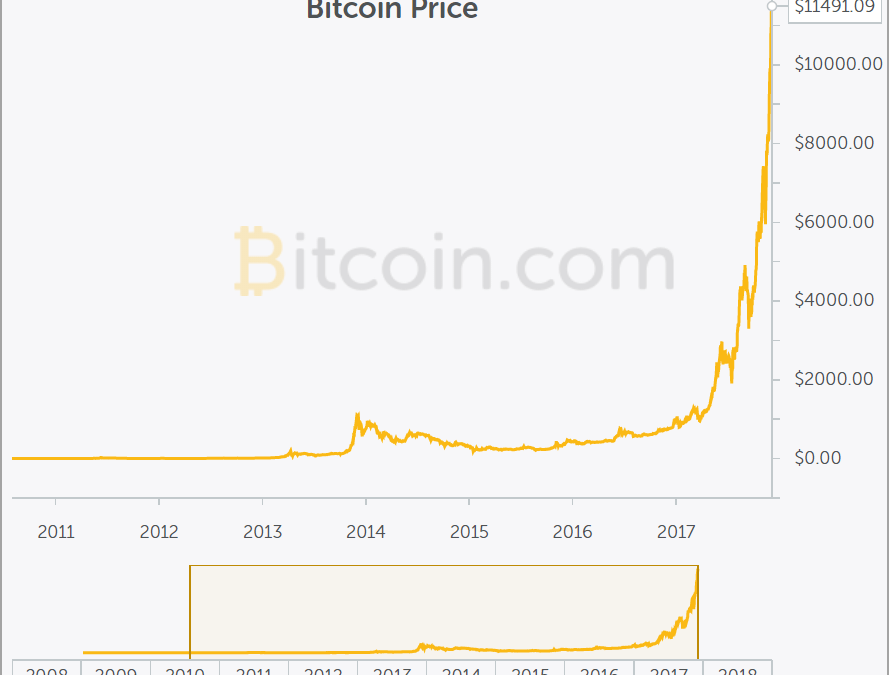
Bitcoin is a currency that was founded/discovered pretty recently in 2009 by a person (still unknown) using the alias Satoshi Nakamoto.The good thing about transacting using Bitcoin is that there will be no middleman required to do the transacting. There is also no fees tagged to transacting with Bitcoin and no requirements […]

What is moat in Warren Buffett’s terms & why it’s important
Moat is important because it protects a company from losing their market share easily which will erode its earnings power over time. This is important for us as investors because we would want the company we invest in to have its earnings grow over time – then the share price will follow – and not the other way round. So, we […]

GameStop Q3 17 Earnings — Glad Going Against The Crowd Was Right
25% of their stores have already been turned to GameStop plus format which is a 50–50 combination of games and collectibles. What is interesting here is that despite lesser space to put video games, they actually see an increase in video games sales. This got to do with the new types of customers that these […]