
Options
Does Warren Buffett Invest In Options? Yes, But It’s Not What You Think
16 December 2020
Options, Weapon of Mass Destruction?
Most people will not associate The Oracle of Omaha with options. Because after all, options are derivatives – which derive their value from the underlying securities such as stocks.
And from Berkshire Hathaway 2002 annual letter Warren Buffett said:
“In our view, however, derivatives are financial weapons of mass destruction, carrying dangers that, while now latent, are potentially lethal.”
So people do not often associate Warren with derivatives. However, in the same letter, Warren also said:
“Indeed, at Berkshire, I sometimes engage in large-scale derivatives transactions in order to facilitate certain investment strategies.”
This means that while he acknowledges the risk associated with derivatives such as options, there are situations where derivates can make sense, even for an astute and logical investor like The Oracle of Omaha.
See also: Our free telegram channel where we share investment insights we do not publish here
Options As An Investment Tool
First off, he approaches options as an investment, not as a gamble.
“I believe each contract we own was mispriced at inception, sometimes dramatically so.” – Warren Buffett
Options are priced using The Black-Scholes Model. They take into account the implied volatility – which is based on how much the stock price has moved in recent times.
Buffett said that the Black-Scholes Model might work for a short time horizon but the value of the model decreases as time passes by. That is because recent stock volatility is not a good predictor of the long-run outcome of the security or stock.
So, how does Buffett leverage the limitations of The Black-Scholes Model?
Also read: Part 1 of 2: Here’s How to Use The Black-Scholes Model to Price Options
Buffett Sells Put
“Our put contracts total $37.1 billion (at current exchange rates) and are spread among four major indexes: the S&P 500 in the U.S., the FTSE 100 in the U.K., the Euro Stoxx 50 in Europe, and the Nikkei 225 in Japan. Our first contract comes due on Sept. 9, 2019, and our last on Jan., 24, 2028. We have received premiums of $4.9 billion, money we have invested.” – Warren Buffett
While retail investors normally sell put options in the listed market, Berkshire generally trades in the over-the-counter (OTC) market. Dealers trade directly with each other.
The Oracle’s Put Strategy
Warren sells options with a very long term time horizon of usually more than 15 years, which is overpriced in his view due to the limitations of the Black-Scholes Model.
Using the premium he receives from selling puts, he uses it to invest.
His options are also “European”. This means that they are only exercisable at expiry. So he does not have to worry about paying out the notional value before the expiry date.
For selling put options, Buffett says that “It’s only the price on the final day that counts.” An elegant way to put it, and an elegant options investing method that is characteristic of The Oracle of Omaha.
Can We Also Sell Puts?
Although most of us will not have the platform to write 20-year put options backed by our huge portfolio, we can still invest in relatively long-dated (around 2 years) options in the listed market.
We also have some advantages by selling puts in listed markets. For one, there is more liquidity for us to sell puts on individual stocks. And usually, those options generate much higher premiums than index options because of the company-specific risks associated with them.
In the OTC market, there are counterparty risks, By transacting in the listed options market, there are generally no counterparty risks as we are transacting with the OCC (Options Clearing Corporation).
OCC is the buyer to every seller and the seller to every buyer in the U.S. listed-options market.
Also read: Is Bitcoin Worth Investing in 2020? Here’s My Quick Thoughts
In Conclusion
Selling put options can be a useful strategy for investors to get paid while waiting to buy a stock they want to own at a certain price.
As with any investments, there are also risks with selling put options. And most of the risks are internal, fear, greed, not understanding the company and its valuation well enough, and being greedy by selling put options using money we do not have or at stock we do not want to own at that price.
If you are interested in exploring options as a part of your investment strategy, I encourage you to learn with Value Investing Mentorship Coaching.
Disclaimer:
The information provided is for educational and general information purposes only and is not intended to be personalized investment or financial advice. We make no promises as to the accuracy or usefulness of the information we present.
Important: Please read our full disclaimer.
Like It? Share It!
Appreciate it if you’ll take one minute to share it on Facebook.
Pay it forward, so more people can benefit 🙂

Chris Lee Susanto
Founder of the value investing blog Re-ThinkWealth.com (if you type “value investing blog” in Google, his blog is likely the first one).
Chris is a big proponent of business-like stock investing. He invests in companies where there is value to be found, be it a turnaround, depressed, value, or quality growth company (compounders). He either buys the stock outright or he profits through selling put or selling call options – or buying call options (buying and selling options are especially dangerous for those who do not know how to properly execute it).
Some of the places where Chris has been invited to speak or have added value as a mentor or writer includes Singapore Polytechnic, SMU Institute of Innovation and Entrepreneurship (IIE), Dollars and Sense, The New Savvy, Value Walk Blog, Investment Moats, NUS Tembusu College, NUS Investment Society, CGS-CIMB Singapore and Internationally in Myanmar.
Being a full-time investor himself, Chris knows that he did not beat the S&P 500 return so far (as of the time of this writing) by listening to stock tips. So, when he teaches, he also doesn’t believe in giving stock tips as it is not sustainable for you in the long run. As of the time of this writing, he is still open to new application in his Value Investing Mentorship™ Club. Feel free to also join his free investment telegram channel here.
Don’t Leave First, Read Also:
The Eight Accounting Fraud or Red Flag Signs To Look Out In Stocks
In this article, I’d like to share eight signs of potential fraud in our stocks portfolio that we should be careful of. These are eight simple potential warning signs of bad financial reporting or early markers […]
My 5 Key Takeaway From AEM Holdings 1H 2020 Results
3. As of 1H20, Most Earnings Paid Out As Dividends Based on AEM 1H20 reports, their cumulative capital allocation breakdown from 2017 to 1H2020 is as follows: Dividends – 47%, Acquisitions – 25%, Capex – 18%, Buybacks – 10%. It is interesting to note that […]
Kodak Stock is Up Over 1,400% in Two Days. Does It Make Sense?
Eastman Kodak Company (NYSE: KODK) opened at $2.15 (Monday) on July 27, 2020, and closed at $33.20 (Wednesday) by 29 July 2020. That is a 1,444.19% increase over a two day period. In this article, I am going to give you some background on the Kodak company, the reason […]

Here Are 4 Reasons Why Intel Stock Plunged 16% Last Friday
Last Friday on 24 July 2020, Intel closed 16.24% down. Although I do not own any Intel stock, I was curious why it fell after releasing its Q2 2020 results. Just a while ago, I saw the news that after 15 years of partnership, Apple decided to break up with Intel and stop using its […]

My 5 Key Takeaway From Temasek Portfolio Value in 2020
1. Temasek Portfolio is Huge. Although I know that Temasek has a huge portfolio, I was surprised to see that it is around the size of Warren Buffett’s. As of 31 March 2020, the net portfolio value or NPV is at S$306 billion. So we have our own Warren Buffett in Singapore, that is […]
What I Learnt From Adam Smith About Investment and Money
Who is Adam Smith? Adam Smith (1723-1790) was a philosopher and economist who was best known for authoring the book An Inquiry into the Nature and Causes of the Wealth of Nations. Wealth of Nations also happens to be one of Warren Buffett’s favourite books […]

A List of Value Investing Funds in Singapore and Outside of Singapore
As a value investor, as a practitioner of value investing, I am very interested in studying funds I view as an executioner of the various value investing methodologies I myself am very passionate about. In this article, I will list down some of the value investing funds in […]

Protected: My Gratitude Journal as An Investor (And The Benefits of It)
There is no excerpt because this is a protected post.
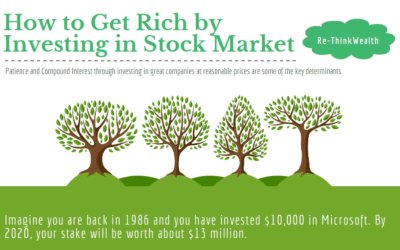
How to Get Rich by Investing in Stock Market? Patience
How do people get rich by investing in stocks? Can we actually get rich by investing in stocks? Yes, we can. But we need to utilize both Patience and Compound Interest in Great Companies. With the proper foundation, framework, character, and skills, I truly believe that […]

Here’s What Sun Tzu Art of War Quotes Can Teach Us About Investing
Sun Tzu Art of War Quotes “He will win who knows when to fight and when not to fight” – We should only invest when there is clear benefit to do so, do not do something just for the sake of doing something. “If you know the enemy and know yourself, you need not fear […]
Thinking, Fast and Slow Book Summary (What I Learnt As An Investor)
In this thinking fast and slow book summary, I will explain to you the various human biases that we have and why it is important for us as investors to understand it. It all begins with a simple premise that we all have two systems in our brain, system 1 and system 2 […]
7 Key Investing Lessons from Charlie Munger & Li Lu Interview
I chanced upon an edited transcripts from Guru Focus of an interview of Munger and Li Lu in one of China’s top finance magazines. Here are the 7 investing lessons I learned from Charlie Munger and Li Lu’s interview: 1. In investing, patience is very […]